
Celebrating Miles At 100
World Of Jazz Overflow Show 5

Miles Davis - Born May 26th 1926
How to celebrate a six decade career by the Master of Jazz who changed the music at least four times? With over 60 studio albums released in his life-time and countless more since he passed - including a massive trove of box-sets - choosing a play-list is nigh on impossible. But I have tried. No doubt seasoned Miles fans will ask why I have missed certain albums and periods out of the list - time it the main reason - I had originally planned a two hour show but ended up with just under three hours, it could have been four or more. This is a representative sample of the artist who dominates my record collection and hopefully it demonstrates his significant role in the history of jazz, rock, funk and fusion.
AUDIO
PLAYLIST
“Dexterity” a quintessential bebop track recorded on 28 October 1947 for Dial Records. Written by Charlie Parker, the composition is based on “Rhythm Changes”. The recording is historically significant for showcasing Parker’s “classic quintet,” featuring a 21-year-old Miles Davis on trumpet. The performance highlights the contrast between Parker’s high-speed, technical virtuosity and Davis’s more restrained, lyrical style.
“Jeru” is a landmark recording from Miles Davis’s Birth of the Cool sessions, recorded on 21 January 1949. The track was composed and arranged by baritone saxophonist Gerry Mulligan, whose nickname inspired the title. The piece is a defining example of Cool Jazz, moving away from the frenetic intensity of bebop toward a more relaxed, light, and structured sound.
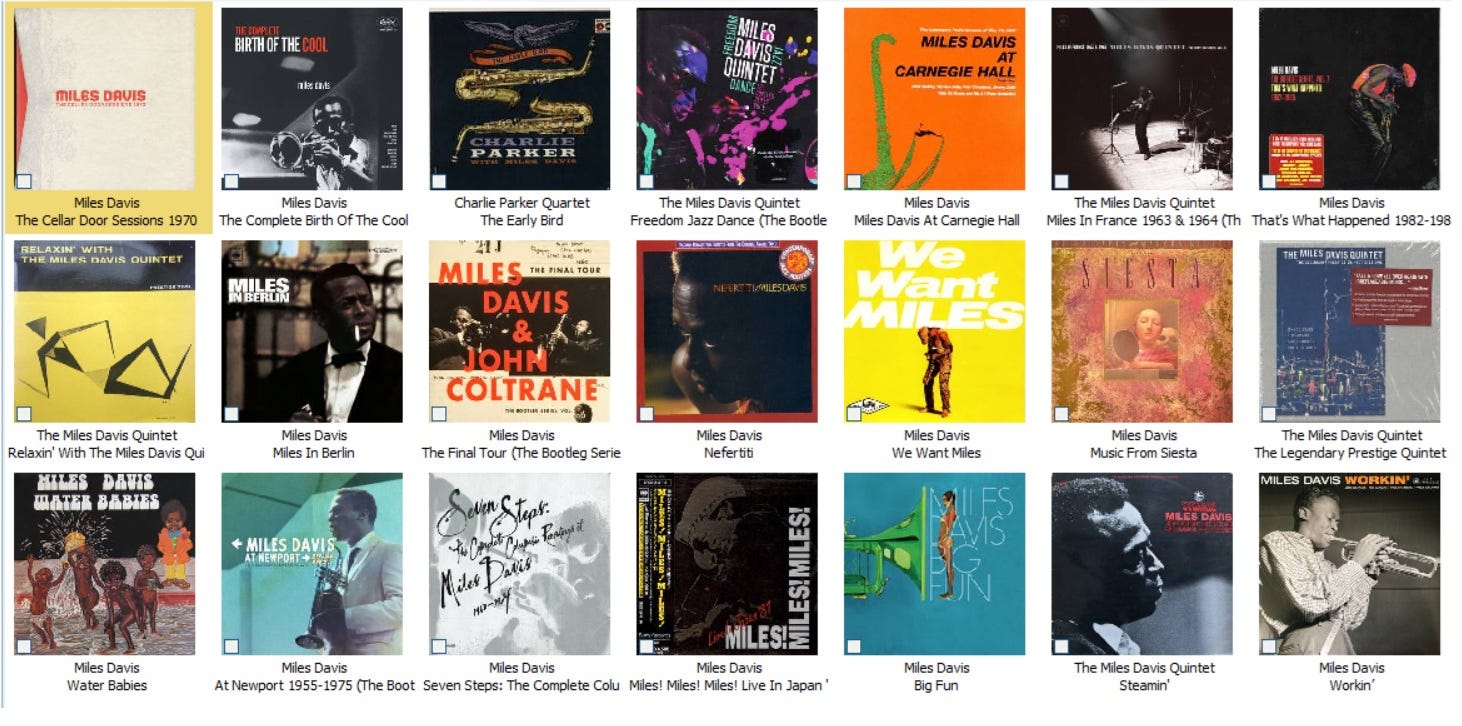
“Orbits” is the opening track of Miles Davis’s 1967 album Miles Smiles. It was recorded on 24 October 1966 and is a quintessential example of his Second Great Quintet’s “post-bop” style. The composition was written by tenor saxophonist Wayne Shorter. It is celebrated for its abstract, unconventional structure and its departure from traditional jazz accompaniment. The track also appears on Freedom Jazz Dance box-set.
The version of “No Blues” (also known as “Pfrancing”) performed at Carnegie Hall is a standout track from the legendary concert on 19 May 1961. While the concert is famous for the collaboration between Miles Davis and the Gil Evans Orchestra, it is important to note that “No Blues” is actually performed by the Miles Davis Quintet alone, without the orchestra’s accompaniment. This performance features one of the transitional line-ups of Miles’s small groups that recorded Someday My Prince Will Come - with Hank Mobley taking the tenor seat from John Coltrane.
There are two famous live recordings of “Joshua” from the Festival Mondial Du Jazz in Antibes (Juan-les-Pins) during the summer of 1963. These recordings are significant as they capture the “Second Great Quintet” (Miles, Wayne Shorter, Herbie Hancock, Ron Carter, Tony Williams) in its infancy, just months after the track was first released on the studio album Seven Steps to Heaven. The featured track is the recording from the 2024 box set, Miles in France 1963 & 1964 - The Bootleg Series, Vol. 8.
The live version of “Jean-Pierre” recorded at the Théâtre Saint-Denis in Montreal on 7 July 1983 is a highlight from Miles Davis’s appearance at the Festival International de Jazz de Montréal. This performance captures Miles during his 1980s comeback period, leading a high-energy electric band that blended funk, rock, and jazz fusion.
“If I Were a Bell” is the opening track of the 1958 album Relaxin’ with the Miles Davis Quintet. Recorded on 26 October 1956, it is one of the most famous examples of the “First Great Quintet” (Miles, Coltrane, Red Garland, Paul Chambers, and Philly Joe Jones) interpreting a Broadway show tune (originally from Frank Loesser’s Guys and Dolls). The track is beloved not just for the music, but for the intimate “fly-on-the-wall” atmosphere that defines the Relaxin’ sessions.
“Milestones” is the final track on the 1964 live album Miles in Berlin. Recorded on 25 September 1964 at the Berliner Philharmonie, it marks a pivotal moment in jazz history: it is the first official recording of the Second Great Quintet in its definitive form. This was the very first time Wayne Shorter performed with the group, having joined just days before the band flew to Europe.
The 21 March 1960 performance of “So What” at the Olympia Theatre, Paris serves as a historic document of the creative tension that defined the final tour of the Miles Davis and John Coltrane partnership. Moving at a significantly more aggressive tempo than the original studio recording, this version is famously punctuated by audible boos and whistles from the Parisian crowd, who were unsettled by Coltrane’s increasingly dissonant and experimental “sheets of sound.” Supported by the rock-solid rhythm section of Wynton Kelly, Paul Chambers, and Jimmy Cobb, the performance highlights a stark stylistic evolution: Davis remains poised and lyrical, while Coltrane pushes the boundaries of modal jazz toward the avant-garde. Now a focal point of The Bootleg Series, Vol. 6: The Final Tour, this recording captures the exact moment the “First Great Quintet” reached its boiling point before Coltrane departed to lead his own revolutionary groups.
Recorded on 7 June 1967 for the album of the same name, “Nefertiti” is one of the most radical and influential works of Miles Davis’s Second Great Quintet. Composed by Wayne Shorter, the track famously subverts traditional jazz roles by having the frontline—Davis on trumpet and Shorter on tenor saxophone—repeat the haunting, circular melody for the entire duration of the piece without ever taking a conventional solo. Instead, the “soloing” is provided by the rhythm section, particularly Tony Williams, whose explosive and polyrhythmic drumming evolves in complexity throughout the track. This reversal of roles created a mesmerising, trancelike atmosphere that challenged the standard head-solo-head structure of jazz, marking a significant milestone in the group’s journey toward a more fluid and avant-garde aesthetic.
Recorded in October 1981, the version of “Back Seat Betty” found on the live album We Want Miles is a definitive example of Miles Davis’s aggressive 1980s funk-fusion sound. The track is built on a heavy, driving groove established by bassist Marcus Miller and drummer Al Foster, providing a thick foundation for the sharp, angular guitar work of Mike Stern. Davis leads the ensemble with stabbing, electrified trumpet phrases, often using his wah-wah pedal to cut through the dense textures of the band. This particular live recording is frequently praised for its raw energy and the way it expands upon the studio version from The Man with the Horn, showcasing a group that had found its collective “voice” and a renewed sense of intensity following Miles’s return to the stage.
Composed by Marcus Miller and Miles Davis for the 1987 soundtrack to the film Siesta, this suite represents a masterful continuation of the atmospheric, orchestral jazz-fusion style Miles pioneered with Gil Evans. “Kitt’s Kiss / Lost in Madrid Part II” is defined by its haunting, cinematic mood, heavily influenced by the “Spanish tinge” that recurs throughout Miles’s discography. Miller’s lush, synthesiser-driven arrangements and layered bass provide a melancholic, sun-drenched backdrop for Davis’s evocative trumpet work, which utilizes his signature Harmon mute to create a sense of deep solitude and longing. The track showcases the telepathic creative partnership between Miller and Davis, blending traditional Spanish musical motifs with a modern, ambient electronic texture that captures the film’s surrealist and emotional undertones.
Originally released on the 1956 album Miles: The New Miles Davis Quintet, “S’posin’” is a charming interpretation of a 1920s popular standard that highlights the early chemistry of the “First Great Quintet.” Recorded on 16 November 1955, the track features a jaunty, mid-tempo swing that serves as a perfect vehicle for the group’s contrasting solo styles. Miles Davis delivers the theme with a playful, lyrical lightness, while John Coltrane provides a more robust, searching tenor saxophone solo that hints at the “sheets of sound” to come. The performance is anchored by Red Garland’s sophisticated block chords and the impeccably tight rhythm section of Paul Chambers and Philly Joe Jones, making it a quintessential example of the polished hard bop sound that would soon define the era.
Recorded in June 1967 during the prolific sessions for Nefertiti but unreleased until the 1976 compilation Water Babies, “Dual Mr. Tillman Anthony” is a fascinating transitional piece that signals the Second Great Quintet’s move toward a more atmospheric, “ambient” jazz style. Composed by William “Buster” Williams (who briefly filled in for Ron Carter on bass), the track is built around a slow, hypnotic, and circular groove that anticipates the “electric” textures of the late 1960s. The performance is notable for its restraint; rather than the high-speed virtuosity often associated with this lineup, Miles Davis and Wayne Shorter deliver spacious, understated lines over Tony Williams’s subtle, shimmering cymbal work and Herbie Hancock’s delicate piano accompaniment. The result is a moody, understated masterpiece that captures the quintet at its most introspective and exploratory.
The live performance of “Round Midnight” at the 1955 Newport Jazz Festival is one of the most consequential moments in Miles Davis’s career, often credited with single-handedly revitalising his professional standing. Performing alongside an all-star group that included Thelonious Monk (the song’s composer), Miles delivered a haunting, definitive rendition of the ballad using his signature Harmon mute. His intimate, vulnerable tone captivated the audience and the critics alike, leading directly to his contract with Columbia Records and the formation of his First Great Quintet. This specific version is celebrated for the “Miles Davis touch”—a perfect blend of melodic economy and emotional depth—and it remains a legendary example of his ability to command a massive festival stage with nothing more than a whisper of a trumpet note.
Recorded in May 1963 for the album Seven Steps to Heaven, “So Near, So Far” is a sophisticated, mid-tempo track that captures Miles during a crucial transitional phase. Written by Tony Crombie and Benny Green, the composition is notable for its fluctuating rhythmic feel, shifting seamlessly between a bossa nova-influenced groove and a standard 4/4 swing. This session marks the recording debut of the “Second Great Quintet” rhythm section—Herbie Hancock, Ron Carter, and Tony Williams—whose youthful energy and “elastic” time-keeping provided a fresh, modern canvas for Davis’s lyrical trumpet playing. The track’s subtle complexity and airy harmonic structure bridge the gap between the modal jazz of the late 1950s and the more adventurous, post-bop explorations that the quintet would soon master.
Recorded at the Shinjuku Kohseinenkin Hall in Tokyo on 4 October 1981, the live version of “Aida” (also known as “Fast Track”) from Miles! Miles! Miles! is an explosive showcase of the trumpeter’s revitalised electric band. This performance is considerably more muscular and up-tempo than the studio version found on The Man with the Horn album, driven by the relentless, popping basslines of Marcus Miller and the aggressive drumming of Al Foster. The track serves as a high-octane vehicle for the group’s “street-funk” sensibility, featuring jagged, distorted guitar interjections from Mike Stern and soaring soprano saxophone lines from Bill Evans. Miles himself leads with commanding, brittle trumpet blasts, frequently using his wah-wah pedal to punctuate the dense rhythmic layers, capturing the raw, improvisational fire that marked his definitive return to the international stage.
Recorded in November 1969 during the fertile sessions following Bitches Brew, “Yaphet” is a sprawling, meditative journey that exemplifies Miles Davis’s move into “spiritual” electric jazz. Released on the 1974 compilation Big Fun, the track is built around a trancelike, repetitive bass motif and a shimmering harmonic bed provided by an expanded ensemble, including Chick Corea and Herbie Hancock on electric pianos and John McLaughlin on guitar. The composition is notable for its use of Indian instrumentation, with Khalil Balakrishna on sitar and Bihari Sharma on tabla, which lends a distinct psychedelic and Eastern texture to the groove. Over this dense, ambient wash of sound, Davis delivers sparse, echoing trumpet lines that prioritise mood and space over technical flourish, creating a long-form atmospheric piece that anticipated the ambient and world-music fusions of the following decade.
Originally released on the 1961 album Steamin’ with the Miles Davis Quintet, “Well, You Needn’t” is a high-energy rendition of the Thelonious Monk classic recorded during the legendary 1956 marathon sessions for Prestige. The track serves as a brilliant showcase for the “First Great Quintet,” opening with a jaunty, chromatic piano introduction by Red Garland that perfectly captures the playful complexity of Monk’s composition. Miles Davis delivers a bright, assertive solo that leans into the tune’s angular melody, followed by a robust and rapidly evolving turn from John Coltrane. The performance is driven by the impeccable rhythmic synergy of Paul Chambers and Philly Joe Jones, whose driving swing and sophisticated accents turn the piece into a definitive example of hard bop at its most polished and spirited.
Originally released on the 1959 album Workin’ with the Miles Davis Quintet, “Four” is a definitive hard bop anthem recorded during the prolific 11 May 1956 session for Prestige. Though often attributed to Miles Davis, the tune was actually composed by saxophonist Eddie “Cleanhead” Vinson, and this version stands as one of its most celebrated interpretations. The track is notable for its crisp, economical delivery, featuring Miles’s bright and melodic trumpet lines contrasted by John Coltrane’s more urgent, searching saxophone solo.
Recorded on 19 December 1970, this live rendition of “Directions” serves as a blistering, high-voltage opening to the final night of the legendary Cellar Door residency. Unlike the more atmospheric studio sketches, this version is a relentless assault of heavy funk-fusion, propelled by the aggressive, distorted wah-wah bass of Michael Henderson and the polyrhythmic drive of drummer Jack DeJohnette. The track is significantly defined by the presence of John McLaughlin, whose searing, rock-influenced guitar solos push the ensemble into a territory of raw intensity. Over this dense, electric maelstrom, Miles Davis delivers sharp, commanding trumpet blasts, steering the band through rapid shifts in texture and volume. It remains a quintessential document of Miles’s “transition” period, showcasing a group that had fully moved away from jazz tradition in favour of a loud, improvisational, and deeply rhythmic “black power” aesthetic.
Think I've got all the obvious Miles LPs plus a few CD boxes (over 65) but I'm still discovering things I've not seen or heard. Very useful article, thanks