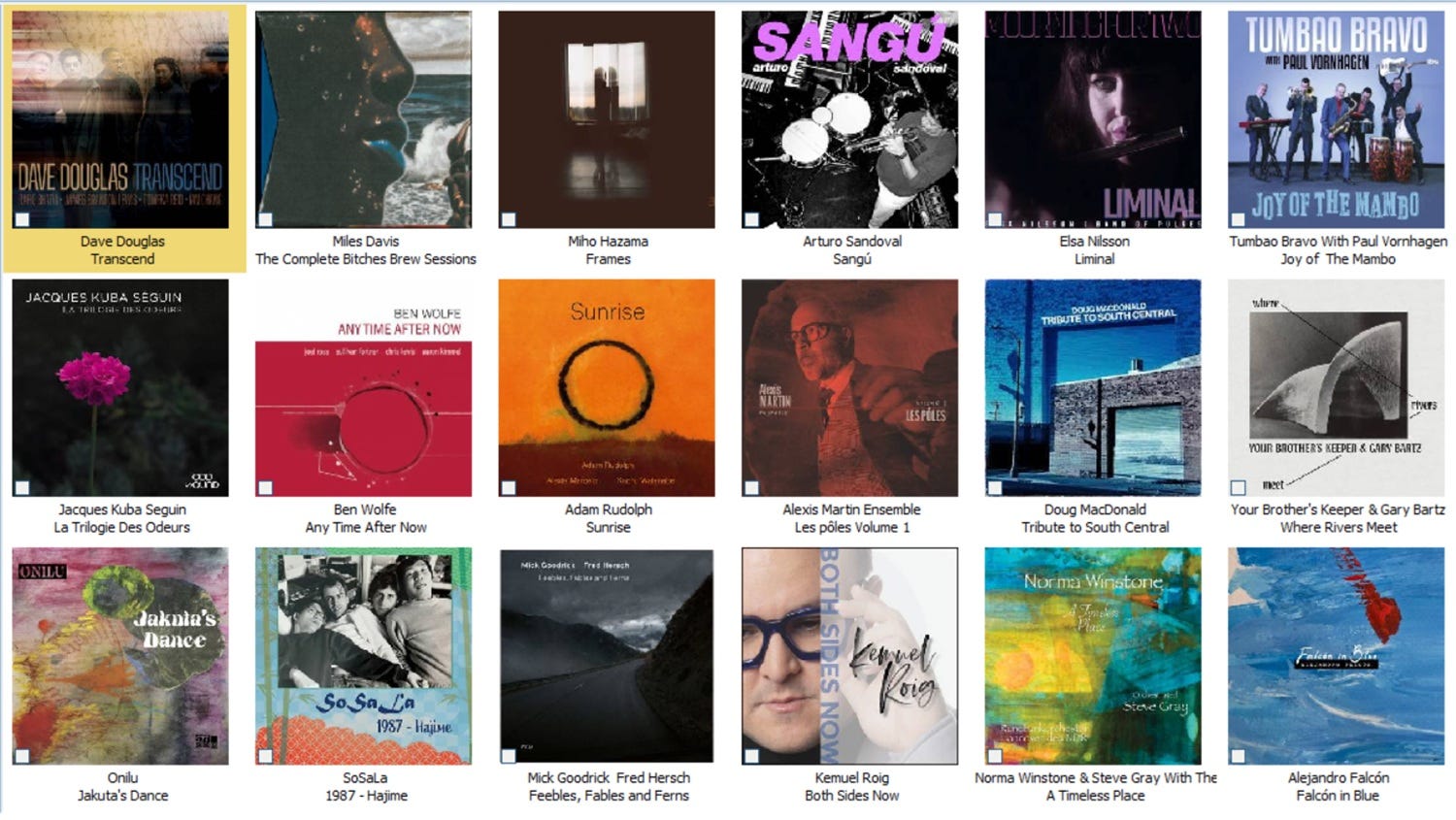
This playlist explores the intersection of narrative composition and global rhythmic traditions, anchored by the rich textures of modern jazz. The journey begins with the structured, cinematic layers of Miho Hazama and Jacques Kuba Séguin’s olfactory-inspired trilogy, before shifting into the vibrant Afro-Cuban and Mambo energies of Arturo Sandoval and Tumbao Bravo. Throughout the selection, the mood oscillates between the intimate, melancholic beauty of Elsa Nilsson and Norma Winstone and the rhythmic complexity of Adam Rudolph and Onilu. It culminates in a definitive nod to the avant-garde, bridging the gap between Doug MacDonald’s hard-bop tributes and the seminal, electric fusion of Miles Davis’s “Great Expectations.”

AUDIO
PLAYLIST
Miho Hazama “The Pioneer’s Quest” from Frames (Edition Records) 00:00 1
Arturo Sandoval “With The People” from Sangú (TM Records) 06:59 2
Elsa Nilsson Band Of Pulses “Mourning For Two” from Liminal (Adhyâropa Records) 09:483
Tumbao Bravo with Paul Vornhagen “Chan’s Song” from Joy of The Mambo (Global Pulse Records) 16:104
Jacques Kuba Séguin “Éphémère” from La Triologie Des Odeurs : Parfum No. 1 (Odd Sound) 21:035
Jacques Kuba Séguin “Paysage pour Muniak” from La Triologie Des Odeurs : Parfum No. 2 (Odd Sound) 23:00 6
Jacques Kuba Séguin “How We Start Again” from La Triologie Des Odeurs : Parfum No. 3 (Odd Sound) 33:507
Ben Wolfe “If Only” from Any Time After Now (Resident Arts Records) 40:478
Dave Douglas “Oclupaca” from Transcend (Greenleaf) 43:389
Adam Rudolph “Inception” from Sunrise (Meta Records) 48:1110
Alexis Martin Ensemble “Pimbina” from Les pôles Volume 1 (Les Productions Alexis Martin Inc.) 52:3811
Doug MacDonald “Captain Bacardi” from Tribute To South Central (Dmac Music) 55:57 12
Your Brother’s Keeper & Gary Bartz “Cauldron” from Where Rivers Meet (Brownswood Recordings) 1:00:1613
Onilu “Holocene Serene” from Jakuta’s Dance (577 Records) 1:06:0114
SoSaLa “Leila” from 1987 - Hajime (DooBeeDoo Records) 1:12:2415
Mick Goodrick, Fred Hersch “Five Excursions” from Feebles, Fables and Ferns (ECM Records) 1:17:1816
Kemuel Roig “The Peacocks” from Both Sides Now (Life In Music) 1:26:0017
Norma Winstone & Steve Gray with the NDR Symphony Orchestra “A Timeless Place” from A Timeless Place (Enodoc Records) 1:35:1218
Alejandro Falcón “Bolera Para Brenda” from Falcón in Blue (Dot Time Records) 1:39:41 19
Miles Davis “Great Expectations” ftom The Complete Bitches Brew Sessions (Columbia) 1:46:3720
NOTES
Frames is Miho Hazama’s fourth release on Edition, reinforcing her standing as a composer and conductor of international recognition. Based in New York, Hazama has built a career defined by detailed large-ensemble writing, long-range musical thinking, and vividly articulated orchestration. Her compositional voice continues to expand in scale and authority, qualities clearly evident throughout Frames. The album returns her to close collaboration with the Danish Radio Big Band, echoing the creative relationship first established on her Edition debut Imaginary Visions (2021). On Frames, Hazama engages directly with the band’s history, drawing inspiration from the musical directors who have shaped its identity over decades It’s their influences that Hazama uses to frame her own compositions. The result is a body of work grounded in legacy yet unmistakably Hazama’s own: composed with clarity, confidence, and an internationally grounded perspective.
With this new release, Arturo Sandoval enters a bold and deeply personal new chapter: one that does not look backward in nostalgia, but reaches forward by going deeper into the source. This album is not simply a return to Afro-Cuban rhythm, nor is it merely a continuation of Sandoval’s extraordinary legacy. It is a living statement of artistic freedom, ancestry, groove, family, and invention from one of the most accomplished musicians of our time. Created in complete collaboration with his son Arturo “Tury” Sandoval III and daughter-in-law/Manager Melody Lisman, the album opened a new space in Sandoval’s life and work, one where generations could meet not only in love, but in artistic dialogue. Together, they set out to create a record that could carry Arturo’s sound into the future while honouring the elemental forces that shaped him: Afro-Cuban percussion, Yoruba spiritual memory, Cuban phrasing, bebop fire, funk, folklore, and the electrifying spirit of risk.The result is a record that feels both ancestral and strikingly modern.
For the past decade, Nilsson has explored unlikely connections among tendencies of human nature, contradiction and pluralism and the natural world. A conceptualist from every angle, the Gothenburg native left Sweden for Seattle in 2005 before settling in Brooklyn in 2010. Her breadth of work engages urgency, high-level improvising and layered, cinematic orchestration; her artistry, an earnest and actionable desire to collaborate with multimodal artists and the changing world around her. “Liminality has been at the front of my mind recently, as I have become fascinated with the in betweens. At times, things move as slow as molasses and simultaneously too fast to be noticed. I believe one of the magical aspects of music is its ability to hold each gradient of a moment for long enough that we can fully experience and observe it. Liminal is an exploration of the processes involved in decision making, the internal steps and actions of making a life altering choice and the executions of action that follow it. Each song represents a motion in the multifaceted cognitive mechanism of navigating a life altering decision. On a personal note, this represents the in-between state of moving through the long dissolution of a 17 year relationship and navigating who I am becoming in the wake of it all.” The album releases June 12, 2026 and features Elsa Nilsson - flutes, FX ; Santiago Leibson - piano; Marty Kenney - electric and acoustic bass; and Rodrigo Recabarren - drums.
A spirited live recording by the veteran Latin jazz ensemble. Led by multi-instrumentalist Paul Vornhagen, the album captures a high-energy performance at the Blue LLama Jazz Club, celebrating the group’s twenty-year history of blending Afro-Cuban rhythms with sophisticated jazz sensibilities. The record features a colourful mix of mambos, cha-chas, and boleros, highlighting Vornhagen’s lyrical flute and saxophone work alongside the intricate percussion of long-time collaborator Dr Olman Piedra. By balancing authentic rhythmic foundations with polished arrangements, the album provides a vivid, immersive experience that showcases the band’s mastery of the genre in a live setting.
Of this project Jacques says “Drawing inspiration from the way a perfume is composed and evolves, I conceived a cycle of three distinct works—a jazz quartet, a large ensemble, and a symphony orchestra with jazz quartet. The sonic and aesthetic worlds are deliberately contrasted, designed as three autonomous musical universes that echo and intertwine around the theme of fragrance and memory”. Parfum No.1 - This movement is performed by a jazz quartet. The music is airy and delicately percussive, shaped by vaporous textures and simple melodies, with improvisation at its core. Like the first wafts of a perfume, Parfum No. 1 is aquatic, luminous, and free.
Parfum No. 2 - The second chapter is written for big band (17 musicians) and features powerful, evocative compositions. With exhilarating arrangements, Séguin explores a rich musical palette, rooted in the tradition of the genre while opening new musical paths.
Parfum No. 3 - The third and final chapter was conceived and composed as a reflection of these memories and life experiences. Bringing together a wide range of musical voices was essential to achieving this vision. The work is structured in movements that intertwine and respond to one another. Under the direction of conductor Alain Trudel, the symphony orchestra accompanies the jazz quartet.
The new recording by bassist, composer, and bandleader Ben Wolfe, featuring vibraphonist Joel Ross, pianist Sullivan Fortner, tenor saxophonist Chris Lewis, and drummer Aaron Kimmel — a program of all-original compositions by Wolfe. The ensemble developed the music across a three-night engagement at Dizzy’s Club in New York City before entering the studio to record the album together in a single day.
Dave Douglas’s 2026 album Transcend is a profound exploration of spiritual and creative legacy, recorded with his GIFTS Quintet featuring saxophonist James Brandon Lewis, cellist Tomeka Reid, guitarist Rafiq Bhatia, and drummer Ian Chang. Drawing direct inspiration from Duke Ellington’s Sacred Concerts, the project blends original compositions with reimagined Ellington pieces like “Come Sunday” and “Oclupaca”. The music balances avant-garde textures and electronic elements with a deep sense of reverence, showcasing a high-energy interplay that seeks to reconcile modern improvisation with the enduring tradition of the sacred in jazz.
Throughout his remarkable 54-year career, visionary percussionist and composer Adam Rudolph has continually ventured into unexplored regions of sound, melding wide-ranging traditions into startlingly original music. Rudolph accomplishes that daunting goal yet again with his new album Sunrise out May 15, 2026 via the composer’s own Meta Records label. The album features Rudolph’s Sunrise Trio with Alexis Marcelo (acoustic piano, electric keyboards, melodica, percussion) and Kaoru Watanabe (flutes, taiko, vocal, electric koto and processing). In its compellingly original sound, Rudolph’s trio blurs countless boundaries: between ancient and modern, organic and electronic, live improvisation and post-production. Their improvisatory explorations take them into undiscovered arenas of sonic invention.
Montreal drummer, composer, and producer Alexis Martin’s debut album as a band leader. Long recognized for his work in film and television, Martin’s distinctive approach to scoring translates beautifully into the free and deeply personal instrumental landscapes on this, the first of a series of records he has planned. Situated at the intersection of contemporary jazz and film music, Les pôles Volume 1 is a collection of evocative pieces inspired by life’s many moments of transition: the constant transformation of the world, memories sparked by certain places, the endless wonder of childhood, and the search for comfort and solace. The album’s title reflects this idea of transformation. Much like the Earth’s magnetic poles, which shift slowly over time, the music explores an emotional territory where perspectives are constantly changing. The album features some of Quebec’s most sensitive and inventive musicians: pianist Emie R. Roussel, double bassist Mathieu Désy, saxophonists Marie-Josée Frigon and André Leroux, trumpeter Jean-François “Fafoui” Gagnon, and cellist Sheila Hannigan.
Doug says “This album was recorded in the South Central neighborhood of Los Angeles in the spring of 2025. The late 1940’s featured a number of live music clubs on Central Avenue, including the famed Dunbar Hotel, which was a main hang for famous artists in town. Similar to 52nd Street in New York City, Central Avenue and South Central Los Angeles was a hotbed for live jazz during this era, and many west coast greats including Buddy Collete, Charles Mingus, and Dexter Gordon found a musical home in this lush environment. Many years later, I began performing in the area at venues such as Marla’s Memory Lane and The Watts Towers with artists such as Ernie Andrews, Jack McDuff, and actress Marla Gibbs. I hope this recording reflects on the echoes of that great time period!”
The lead single from a new studio album capturing a rare meeting between generations of jazz musicians. The full album will be released on June 19, 2026 via Brownswood Recordings, as the label celebrates its 20th anniversary, the record brings together Bartz’s jazz lineage and a new collective emerging from London’s vibrant jazz scene. Your Brother‘s Keeper is a new collective assembled by drummer and producer Jake Long and rooted and shared in musical dialogue and improvisation. Featuring Ali MacSween (piano, synthesizers and modular FX), Axel Kaner-Lidstrom (trumpet), Twm Dylan (double bass), Tim Doyle (percussion) and Chelsea Carmichael (tenor saxophone), alongside Long on drums, the group reflects a scene that has reshaped the sound of contemporary jazz over the past decade.
Percussion ensemble Onilu debuts on 577 Records with a work of striking scope, depth, and creative fire: Jakutá’s Dance. The group delivers a sonic vision that is at once elemental and exploratory—rooted in tradition yet unbound by it. Founding members Kevin Diehl and Joe Chambers are joined by Craig McIver and Daniel Villarreal, forming a dynamic quartet whose collective experience spans generations and geographies. Together, they draw from an expansive array of percussion instruments—ranging from global drum traditions to vibraphone, marimba, piano, and electronics—creating a richly layered and immersive sound world. The album’s title reflects its spiritual and cultural grounding. “Onilu,” from the Yoruba language, translates simply as “drummers,” while “Jakutá” refers to the deity of drums, music, dance, thunder, lightning, and fire. That elemental energy pulses through the music: at once ritualistic and spontaneous, meditative and explosive.
Another retrospective CD this time, re-releasing the 1987 originally released on Japanese independent label Kampai Records. The music on this album comes from the Japanese free jazz-punk-noise scene of the 80s. No band in Japan sounded like ALEF, a short-lived but pioneering multimedia performance group active in the mid-1980s. The music was a Dadaistic blend of jazz-core, progressive rock, and avant-garde, often described as rock-jazz-industrial & with heavy improvisation.
Feebles, Fables and Ferns captures a rare one-time coming together of luminaries Mick Goodrick and Fred Hersch, both active in Boston at the time, recorded in Hersch’s studio in New York, in August 1988. Looking back at the session almost four decades later, Hersch notes how “the highlight to me is just the level of ensemble playing. There was a lot of profound listening going on between the both of us.” The expansive grasp of both musicians’ language and expressive abilities on their respective instruments is to the fore throughout this rich program. “Mick was a pretty modest guy. And he was very under-recorded,” Fred remembers. “I call him the guitar whisperer; He was very content to teach, be behind the scenes. That was kind of his way of doing things. And towards the end of the era of my recording studio, which was ca. 1983-88, I asked him to come down and record some duets with me. So he came to NYC and we made this duo thing and it just worked out on the spot.”
Pianist Kemuel Roig’s solo album Both Sides Now is filled with his own brand of beautiful music. The pianist’s thoughtful ruminations, caressing of some of his favorite melodies, and subtle creativity blend together his Cuban heritage and classical training with his quietly joyful and inventive jazz interpretations.
In 1990 the internationally renowned NDR radio orchestra (now the NDR Radiophilharmonie) invited the peerless singer and lyricist Norma Winstone to collaborate on a broadcast session. She immediately turned to pianist and arranger Steve Gray and working with the superb radio band they created together an unforgettable, beautiful suite of songs including classic repertoire and modern gems featuring Norma’s own lyrics. Released for the very first time on Limited Edition vinyl, CD and digital this is a rare opportunity to hear one of our greatest jazz singers backed by a full orchestra. The title track is the first single from the album.
Havana-based composer, and arranger Alejandro Falcón with a new release as part of Cuban Notes, the ongoing artistic and cultural project produced by Johanan Bickhardt, founder of the label, and guitarist Roni Ben-Hur. This first album of the series revisits foundational Cuban genres—among them danzón, son, rumba, cha-cha-chá, and bolero—from the perspective of the present. Rather than treating these forms as heritage pieces or nostalgic artifacts, Falcón approaches them as living languages, shaped by memory, experience, and artistic exchange across borders. The album reflects a broader commitment to collaboration between Cuban and international musicians.
The version of “Great Expectations” found on the Complete Bitches Brew Sessions box set (running approximately 13:48) is the unedited recording of the track’s first section, before it was spliced with other material. In its original 1974 Big Fun release, producer Teo Macero famously edited this take together with a Joe Zawinul composition called “Orange Lady” to create a single 27-minute suite. This shorter, standalone version strips away that second half, allowing the listener to focus entirely on the November 1969 session’s unique “East-meets-West” fusion. Without the transition into “Orange Lady,” the track remains a singular, hypnotic exploration of North Indian classical textures, featuring Khalil Balakrishna’s sitar and Bihari Sharma’s tanpura, all held together by a tight, circular bassline and Miles’s use of the Harmon mute.