
The Fall Live : 1977
First Steps - 12 Gigs

During the COVID pandemic I had time on my hands so I finalised an updated website of all of The Fall’s live gigs that Martin Peters and myself had worked on for well over ten years . Called The Track Record this mammoth endeavour covered every known gig the group played and attempted to keep a record of songs performed and musicians involved. It is an incomplete piece of work in progress as new information appears on a semi-regular basis. As we approach The Fall’s 50th anniversary I am going to occasionally dip into that archive to look at the early days of the group. Here is an overview of the first dozen gigs.
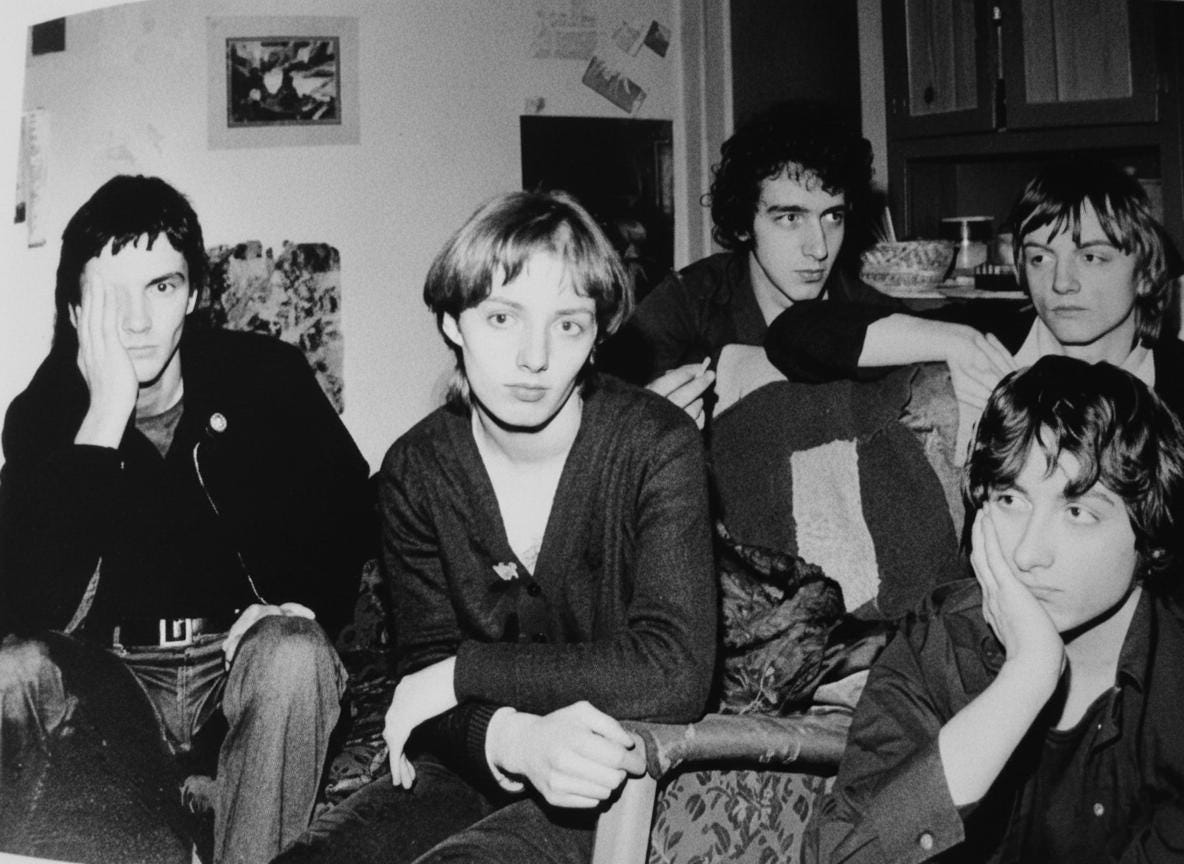
There are just over 1700 gigs in the groups live canon so whether I get around to looking at all of them is under review and subject to available time . Anyhow - here is the first part of the first year.
In this period there were debut performances for the songs :
Hey Student/Fascist - a studio recording (as Hey! Student) eventually appeared on the Middle Class Revolt album in 1994
Race Hatred - No studio recording
Bingo Master’s Breakout - Released on the first single as “Bingo Master” in 1978
Repetition - Released on the first single
Last Orders - Live version released on the compilation Short Circuit - Live at The Electric Circus in 1978
Futures and Pasts - Released on the first studio album : Live at the Witch Trials
Frightened - Released on the first studio album : Live at the Witch Trials
Copped It - Released on The Wonderful and Frightening World of The Fall album in 1984
Industrial Estate - Released on the first studio album : Live at the Witch Trials in 1979
Sten Gun Rock - No studio recording
(It) Don’t Turn Me On - No studio recording
Louie Louie - Live version released on Live 1977 album in 2000
Psycho Mafia - Released on the first single
Oh! Brother - Released as a single in 1984 and then on expanded versions of The Wonderful and Frightening World of The Fall album
Roll The Bones - No studio recording
Entitled - A song of the same name appeared originally on the Hey! Luciani EP in 1986
Your Heart Out - A version was released on the Dragnet album in 1979
The above list clearly demonstrates Smith’s practice of revisiting earlier material later in the life of the group.
The first gig took place at the then newly formed North West Arts Association Monday night meetings at their venue on King Street in Manchester city centre. For many years it was thought that this gig took place on 23rd May but the general accepted date appears now to be 16th. Evidence emerging in 2022 as part of the auction of Mark Smith’s belongings, plus comments from Una Baines indicate that the likelihood was that the 16th was the date of the first gig. Una did not play the gig as the loan to buy her keyboard had not come through so the initial outing was the four piece of Mark Smith, Martin Bramah, Tony Friel and Steve Ormrod. The probable set list included Hey Fascist, Race Hatred, Bingo Master’s Breakout, and Repetition. However at the time Hey Fascist was known by it’s earlier name of Hey Student (which also became its later name). There is no known recording of this gig There is a report of the gig in Simon Ford’s Book “Hip Priest” (pages 22-23) which gives some insight of how it was delivered. At the time of writing the venue is now a Tapas Restaurant “El Gato Negro”.
The importance of the groups’ association with Buzzcocks at this point cannot be understated. That band and their manager Richard Boon were extremely supportive in giving The Fall much needed exposure whether through gigs or funding recordings.
The next gig was June 3rd at a venue on Devas Street in the Manchester University district called The Squat1. There is no known recording or set list but it was Una Baines first performance and local writer Mick Middles reviewed it, and this is also mentioned in Simon Ford’s book. The appearance was part of a “Stuff the Jubilee” festival -- also on the bill were emerging bands Drones2, Warsaw3, the Worst4, the Negatives5 and Jon The Postman6. The Fall and The Postman are not listed on the extant publicity for the event.
Despite reports for many years that Steve Ormrod only lasted one gig there is ample evidence from The Fall Family Archive auction7 that he stayed around for a bit longer.
Gig three saw the group back at North West Arts - this was a previously unknown performance until it was revealed as part of the second Omega auction of Smith’s belongings on 12th October 2022.
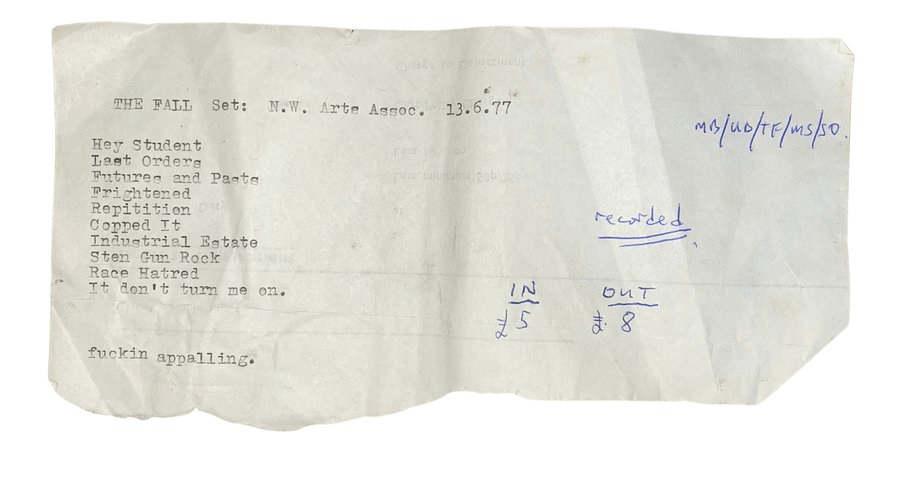
Smith’s two word review given at the bottom of the playlist just about sums it up. There is also the indication it was recorded. This is historically important as these are the first known recordings of all of the above songs and the group. This date was the recording released by Cherry Red as part of the “70s Box Set” as the “first gig” (which it was not of course as Baines keyboards can be heard clearly on the recording) net of the opening tracks Hey Student and Last Orders. This is corroborated by the fade in on Futures and Pasts on the release. This ties in with Mark Smith’s statement in an NME article in March 19788 that the gig at the Vortex on 4 July (see below) was the sixth gig. The recording is pretty basic but it does give a clear indication of what the nascent Fall sounded like.
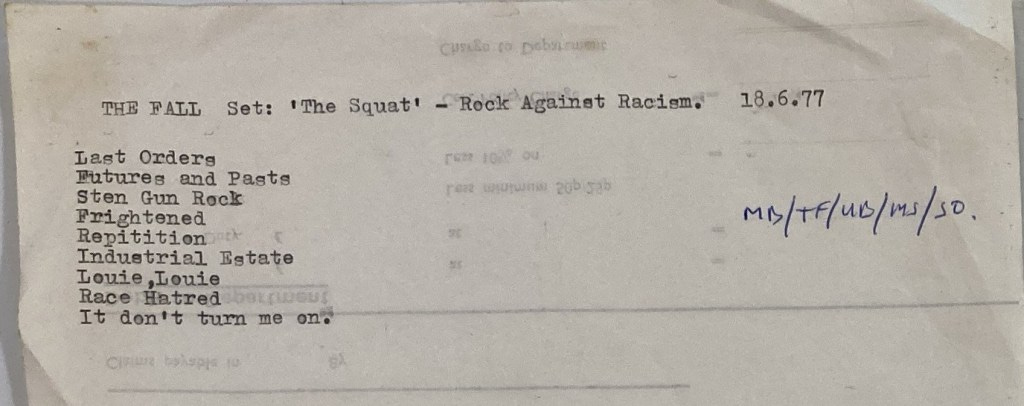
The group were back at the Squat on June 18th. There is no known recording but the set list survives. This is notable for first appearance of The Kingsmen’s “Louie Louie” which was a bit of a gig staple for Manchester bands at the time.
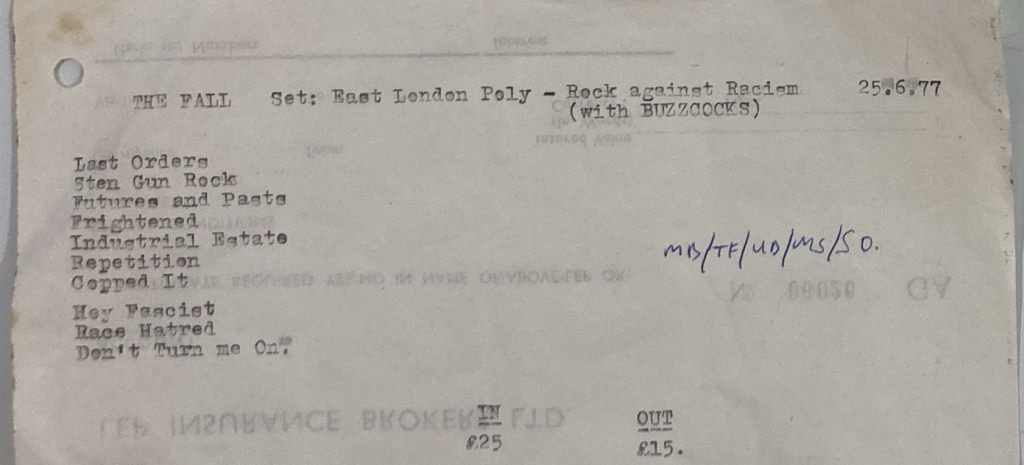
June 25th saw the groups first gig outside Manchester, and the first of an eventual 190 gigs in London. This was Steve Ormrod’s last gig with the group.
Another gig in London followed, again supporting Buzzcocks. There is no known recording of this gig. The set list appeared 11th August 2022 as part of the auction of Mark Smith’s memorabilia.
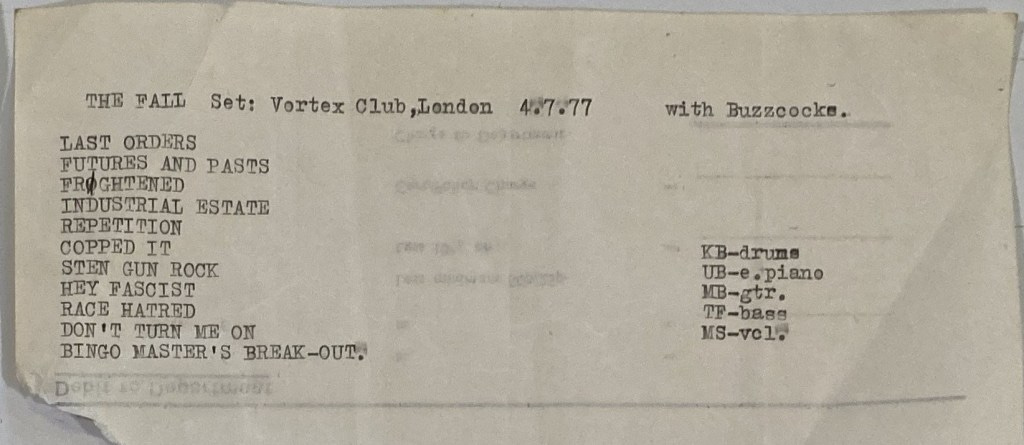
This was Karl Burns’ first gig replacing the departed Ormrod. Prior to The Fall, Burns had previously played with Martin Bramah in a group called Nuclear Angel. George Gimarc’s Punk Diary 1970-1979 reported : “Opening act The Fall are greeted with great indifference. Their music is aggressive but not as banal as some openers can be. It’s only The Fall’s sixth-ever gig. They got together in Manchester late last year and have a harsh, unschooled approach to music.” Gimarc’s observation that this was the sixth gig is consistent with the NME article by Malcolm Heyhoe.
Friday, 22 July, 1977 at Hulme Labour Club, Manchester was a Rock against Racism gig with the group again supporting Buzzcocks. There is no known recording or set-list of this gig.
4th August saw the group supporting Penetration at Manchester’s Rafters9 venue. Whilst there is no known recording a set list survives.
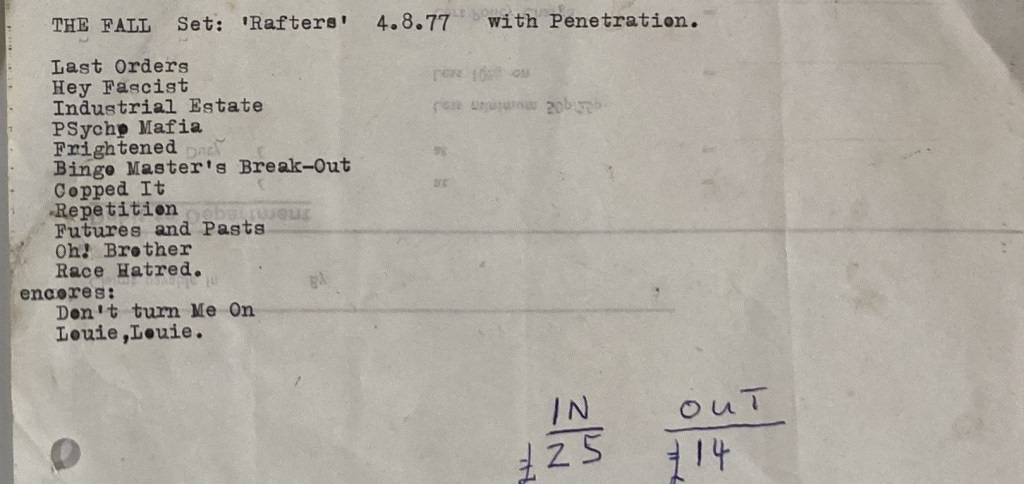
This gig is notable for the first performances of Psycho Mafia and Oh! Brother - both songs would last much longer into the groups career than the other extant material.
My partner in musical crime Mr Moss was in attendance…..
Rafters 1977 with Penetration , the first time I saw The Fall , I was floored they were not what I was expecting, I thought they’d be a punk group but to my delight they were much much more , hypnotic and sinuous with a singer who didn’t try to sing but gave off a vibe that seemed to suggest he knew how great the Fall were and if we didn’t get it we were fools , I remember them playing Repetition and it coiling around and around as Mark spat out each barbed. lyric , I was hooked, I didn’t stay for Penetration , I knew what they did and the Fall had just made that seem redundant.
Future group guitarist Craig Scanlon recalls that this was his first Fall gig as a punter.10
Two weeks later the group managed to fit in two venues on one evening. The first was an aborted outing at St. Georges’ Community Centre in Collyhurst, Manchester which appears to be a youth club gig where The Fall was asked to stop playing after a couple of numbers as the organisers realised they had booked the wrong type of act. There is no known recording or set-list of this gig (if you can call it that). The group packed up their gear and travelled less than a mile to The Ranch11 on Dale Street where they managed to complete a set. The only artefacts from this gig are some excellent photographs by Kevin Cummins which are reproduced in Brian Edge’s book “Paintwork”. The following day Smith was sacked from his day job at Crowe & Co for persistent bad time-keeping12.
Three days later the group supported Eater13 at the Electric Circus14, again in Collyhurst. A more successful outing this time was captured on one of Smith’s set-lists. Notably the lack of a work typewriter following his dismissal sees them rendered in hand-written form for the first time.
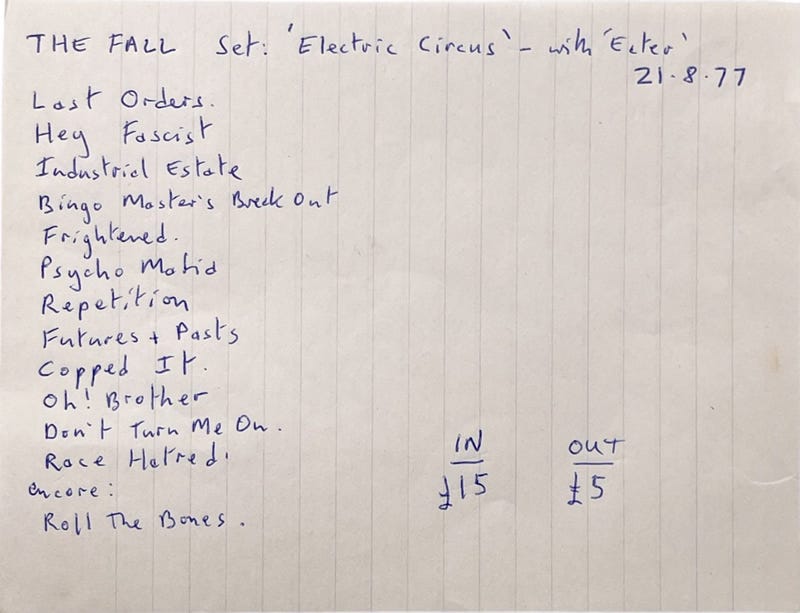
This is a gig with the longest set list to date notable for the first performance of Roll The Bones - a song never recorded in studio and of which there is no known live recording as far as I know.
September saw the groups first foray into Merseyside with a gig at the Kirby Suite in Knowsley. A detailed look at the event can be found in the Psychogeographic Review
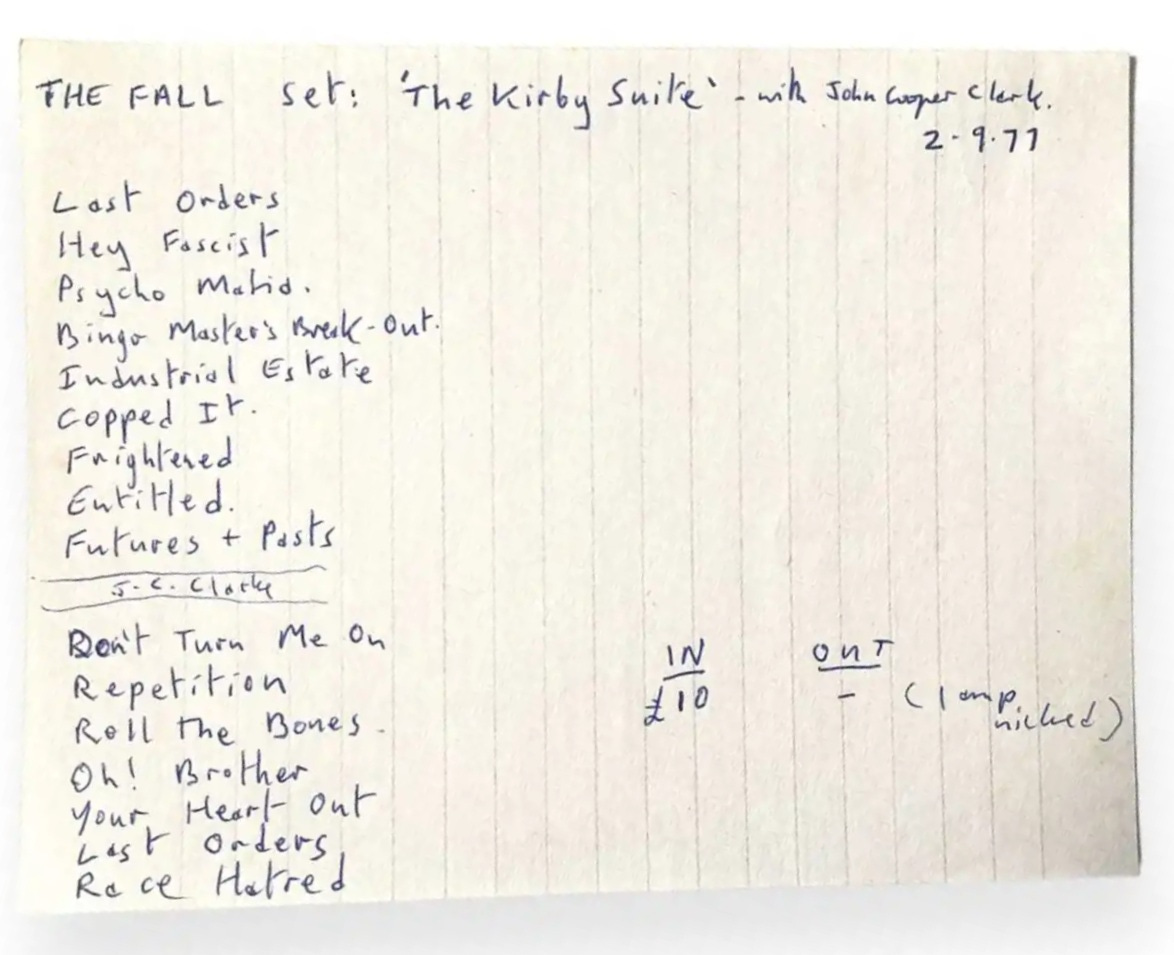
A notable gig for the first performances of Entitled - a song that only lasted two gigs and if it is the same one it later appears on the b-side to the Hey Luciani EP in 1986 - and, Your Heart Out also initially performed for two gigs but returned in 1979 performed by the Dragnet line-up.
So that is the first dozen gigs of one of the most important bands of the last 50 years. The constant line-up changes and set-list revisions demonstrate traits that would be a key feature across the groups history.
"The Squat was situated in a decrepit building that had once been the home of the Royal Manchester College of Music. When the College revealed plans to demolish the building, it was occupied by students who then successfully campaigned for it to be turned into a live music venue". Simon Ford. Wire Magazine. May 2002.
As far as I know still performing and not to be confused with Tropical Fuck Storms Gareth Liddiard’s band of the same name.
Stiff Kittens as was, then Warsaw, then Joy Division.
The Worst were a brief but influential Manchester punk group formed in 1976–77, remembered for their refusal to engage with the music industry and their commitment to a raw, anti‑establishment ethos. Centred around Alan Deaves, Robin Utracik, Ian “Odgie” Hodges and Dave “Woody”, they emerged from the city’s early punk network via manager Steve Shy of Shy Talk fanzine and the Ranch Bar scene. They played early Rock Against Racism events, embraced deliberate musical minimalism, often improvised material live, and rejected all record‑label offers on principle, leaving behind no official recordings. Their gigs were chaotic, spontaneous and defiantly non‑commercial, sometimes accepting cuddly toys as entry “payment”. With their website now gone and no physical output, their legacy rests on eyewitness accounts that position them as one of the purest expressions of Manchester punk’s uncompromised DIY moment.
The Negatives emerged in the late 1970s punk scene, appearing in fanzines and performing at venues such as the Electric Circus. A 1977 photograph places the group in the listening booths of the old Virgin Records shop, with a line‑up including Kevin Cummins on drums, Richard Boon on sax, Merlin on guitar and Paul Morley on vocals, alongside backing vocalists Stephanie, Carol and Jodi.
Tim Lyons observes “I was wondering when the first time I saw them was. I couldn’t remember if it was the last night at the Electric circus or the Squat gig, I think it was the first time they played Squat, you didn’t state Jon the Postman was on! I was pretending to be Rashied Ali on the drums with Jon that night, to cover up the fact that I had no idea how to play the we used the Worst’s Chad Valley drum kit. But it’s at that gig that Mark made friends with us”.
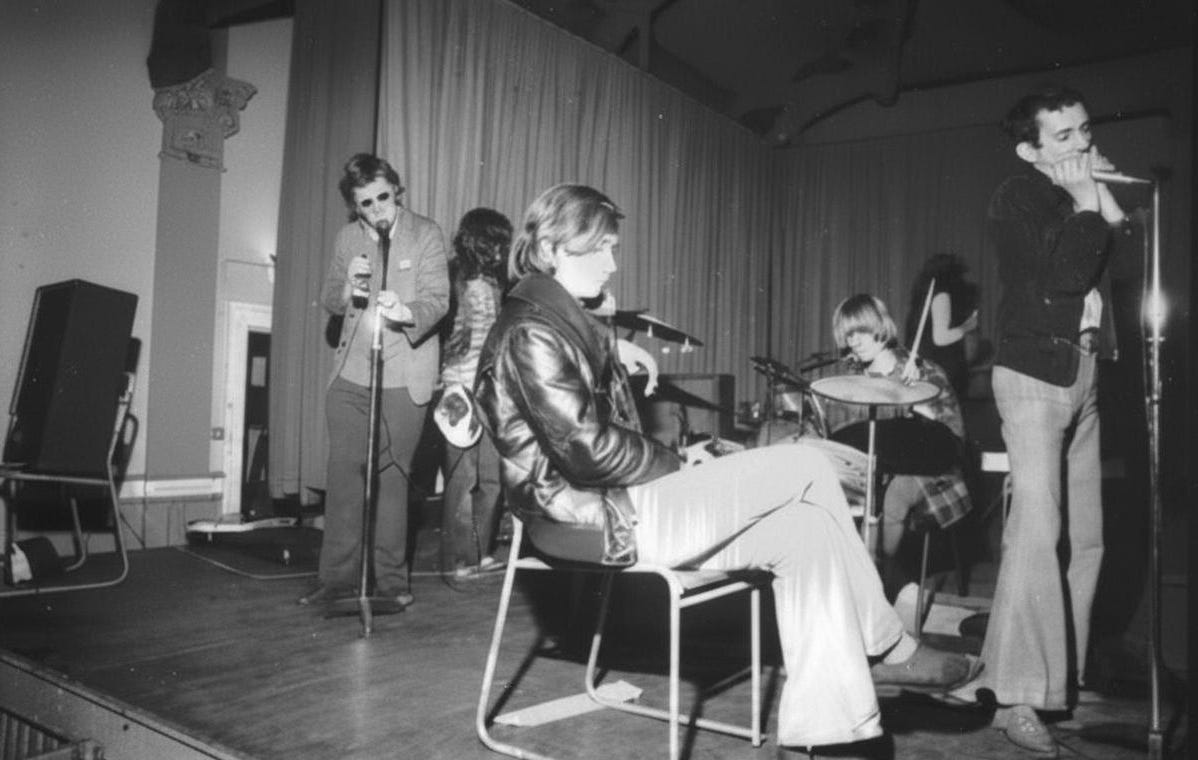
Following Mark E Smith’s death his family organised a couple of auctions of historical artefacts from his belongings including a number of early set-lists.
“Why The Fall Must Rise” Malcolm Heyhoe NME March 1978
Rafters operated through the 1970s and early 1980s in the basement of St James’s Buildings on Oxford Street, becoming a key site for Manchester’s emerging punk, post‑punk and jazz‑funk scenes. It hosted early appearances by acts who would later define the city’s musical identity, with figures such as Rob Gretton working there and DJs Colin Curtis and John Grant establishing influential jazz‑funk nights. Its role as a busy live room during the rise of punk and its later transition into Jilly’s underlines its place as one of Manchester’s formative underground venues.
Oh! Brother podcast 25th April 2022
The Ranch on Dale Street in Ancoats was beneath Foo Foo’s Palace and was connected to the Foo Foo’s by a door behind the bar As well as playing the staples of Bowie and Roxy Music, the venue was host to early gigs by Buzzcocks, The Fall and The Distractions.
Dismissal letter from Smith family auction.
Eater were a London punk group formed in 1976 by Andy Blade, Brian Chevette, Ian Woodcock and Dee Generate, notable for being one of the youngest bands in the first wave of UK punk. They emerged from the same early circuit as the Damned, Buzzcocks and Slaughter & The Dogs, gaining attention for fast, abrasive songs, a raw live reputation and a habit of covering glam and proto‑punk material at high speed. Their 1977 releases – the single Outside View, the album The Album, and appearances on early punk compilations – captured a deliberately unpolished sound that aligned with the DIY ethos of the period. Although they split in 1979 after personnel changes and limited commercial traction, their recordings became staples of punk reissue culture, and later reunions kept the name active on the underground circuit.
The Electric Circus in Collyhurst was a short‑lived but influential Manchester venue operating mainly between 1976 and 1977, housed in a former cinema and later a bingo hall on Collyhurst Street. It became a key site for early UK punk, hosting formative appearances by the Sex Pistols, The Clash, Buzzcocks, Warsaw, The Fall, and others, often in rough, improvised conditions that reflected the building’s declining state. Its closure in October 1977 followed safety concerns and redevelopment pressures, but its brief existence is widely regarded as a catalyst for Manchester’s late‑70s independent music infrastructure, linking directly to the emergence of Factory Records, local fanzines, and the city’s DIY gig circuit.