
The Fall Live : 1977 part 2
Consolidation And Approaching Change

Continuing an ongoing look at the live appearances of The Fall. The second half of 1977 consisted of 11 dates although there is some confusion about a date in October and some records have 12 dates reported. The line-up remained consistent throughout, but change would come at the end of the year.
SONG DEBUTS
Dresden Dolls - There is no official studio recording but a bootleg recording of a home rehearsal was released by Total Eclipse. Subsequent releases of the same recording turn up on a variety of different releases including Backdrop (bootleg LP), Backdrop (official release of above bootleg), Live at the Witch Trials (Expanded), Live at Deeply Dale (includes rip of a Granada TV feature in 1978), 13 Killers (bootleg version), and Creative Distortion Vol. 2. The set released on Live 77 (see below) includes the track. The lyrics were written by Una Baines and are an attack on faux punks, most of whom borrowed their style from Sex Pistols fans/hangers-on The Bromley Contingent who were wearing swastika armbands . Baines spotted that this had become just another uniform and the triumph of short term fashion over proper socio-political change.
Stepping Out - again no official studio recording but has the honour of being one of the first two Fall songs committed to vinyl on the Short Circuit release. It would eventually be played 51 times between October 1977 and December 1979. One of few songs in the canon with a Tony Friel writing credit on it. The lyric is apparently influenced on Smith’s experiences at work in Trafford Park
Your Heart Out - would eventually appear on Dragnet. It was played 23 times between 1977 and 1981
Weeds of Evil - no known studio recording or indeed any recording at all. The song managed two appearances before being retired. Notably in late 1976 and early 1977, Smith briefly considered "The Weeds of Evil" as a group name. The moniker was inspired by the opening narration of the American radio serial The Shadow ("Who knows what evil lurks in the hearts of men?... The weed of crime bears bitter fruit...").
THE GIGS
Despite an advert in a local newspaper a gig supporting Buzzcocks ( listing in the Staffordshire Newsletter 26 August 1977) a gig on Monday on 29th August at Top of the World, Stafford appears not to have taken place. The plausible explanation is that the Buzzcocks were in the recording studio at that date.
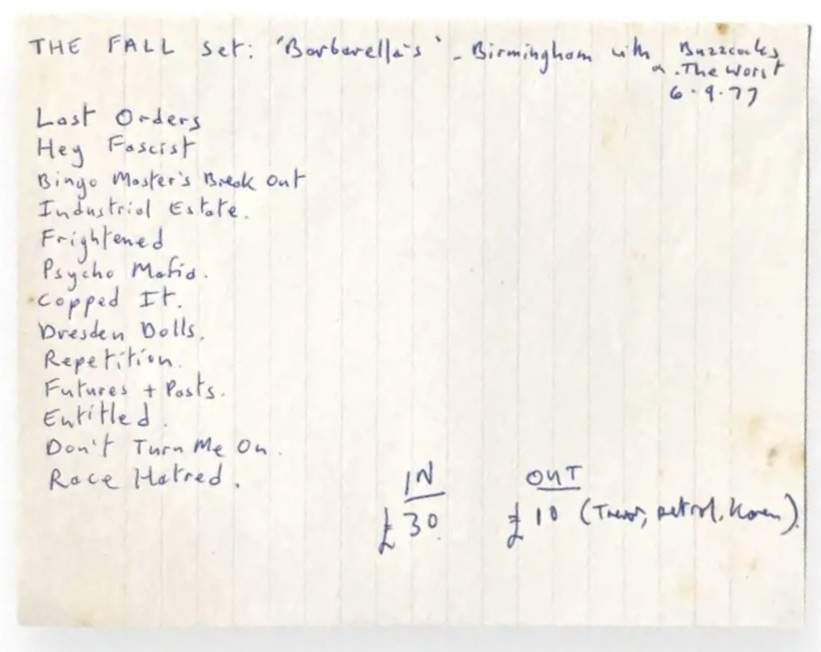
The opening gig of this second tranche was the groups first trip to Birmingham, again supporting Buzzcocks, with The Worst also appearing. The venue was Barbarella’s1, there is no known recording of the gig but a set-list survives. Dresden Dolls was debuted.
The closure of Manchester’s Electric Circus was marked with a weekend of gigs with the final night, on October 2nd, including The Fall. The groups first official release came on a various artists compilation of that event with Stepping Out and Last Orders featured. There is no record of what else was played although there are ongoing rumours that someone somewhere has the complete set on tape. The two songs reflect the emerging sound of the group2.
Two days later the group were reportedly back in London at the Marquee Club supporting Buzzcocks. Unfortunately there is no recording or set-list. The Marquee website indicates Adam and the Ants were supporting rather The Fall and The Worst. As can be seen from other dates Smith was meticulous about keeping setlists at the time. The absence of a physical setlist for this date is a significant red flag compared to other 1977 gigs where such artifacts exist. Also there is the “Four-Band” Problem: The Marquee typically hosted two or three bands. A line-up of The Buzzcocks, The Worst, The Fall, and Adam and the Ants on a single Tuesday night would be highly unusual for the venue’s scheduling. Adam and the Ants’ official timeline definitively lists 4th October 1977 at The Marquee. My assumption is that the person who reported the October 4th date was getting it confused with the same line-up which definitely played on November 22nd (see below).
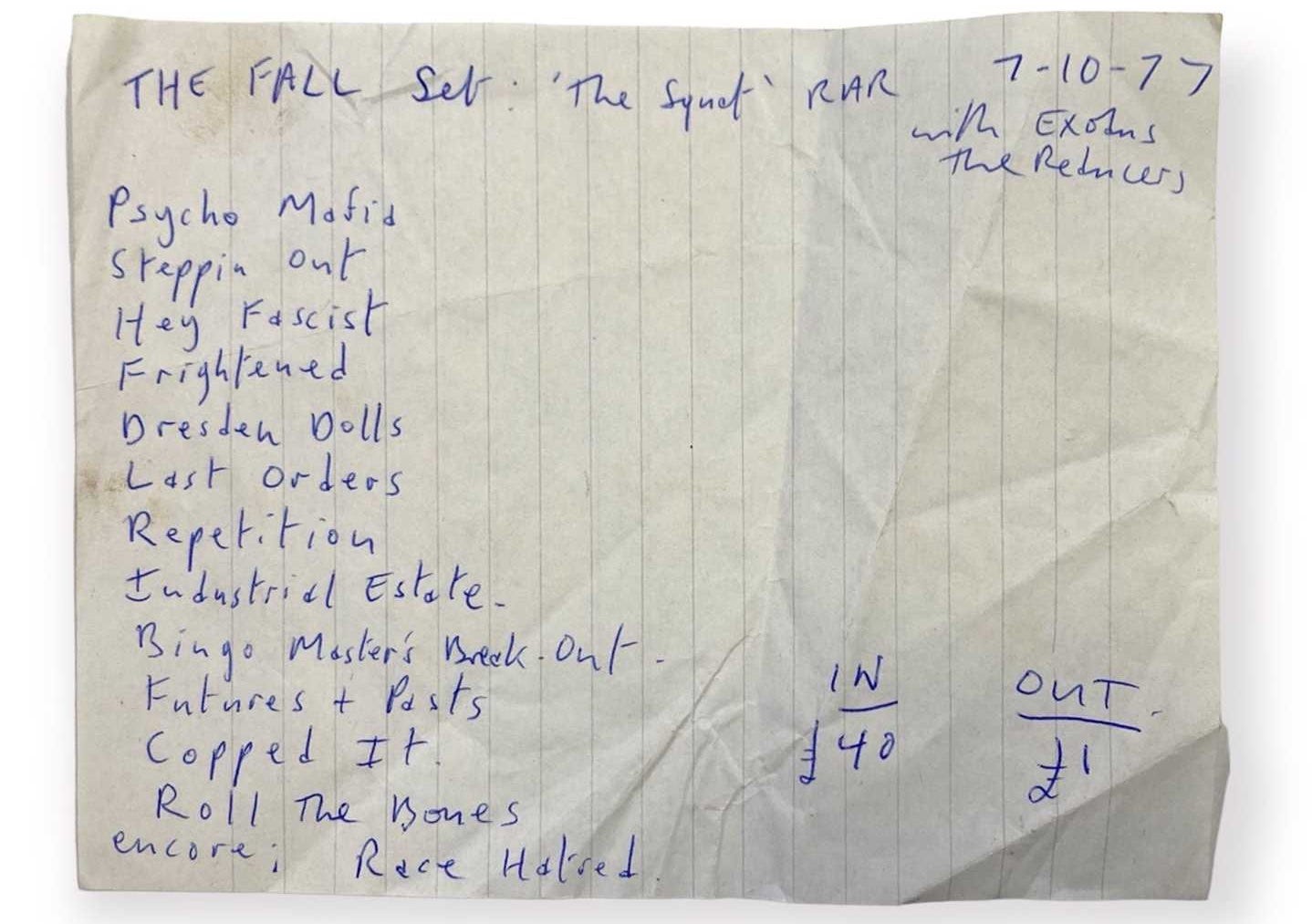
Friday, 7 October, 1977 the group were back at The Squat for a Rock Against Racism gig. There is no recording. Supports were Exodus3 (aka X-O-Dus) and The Reducers4.
There are occasions when the dates/locations of Fall gigs get mired in a mixture of controversy and mis-reporting. Another case in point is the gig on Thursday, 20 October, at Katie’s, in Beeston. There was historically some dispute over the actual date of this gig. In Simon Ford’s book “Hip Priest”, he writes that the gig which was thought to have taken place on 20 October, actually took place four days after the Band on the Wall gig in Manchester (11 November, the night before the gig in Eric’s, Liverpool). Ford quotes the review in the New Musical Express5. There are a couple of problems with the accuracy of Heyhoe’s review. Despite the review stating the gig was in Nottingham, Beeston is actually a town in the Borough of Broxtowe, in the county, 3.4 miles south-west of Nottingham city centre. The Bored Teenagers website 6 records the gig as being played on 20th October with support from The Worst, The Slugs & Some Chicken. The Heyhoe review replaces the latter two supports with The GTs7. It seems clear that the date was 20th October following further extensive research by Dannyno8. The setlist from the review included Hey! Fascist, Stepping Out, Frightened, Repetition
Friday, 28 October, 1977 at Rafters is notable for a number reasons. Whilst their is no known recording a set-list survives from the Smith auction.
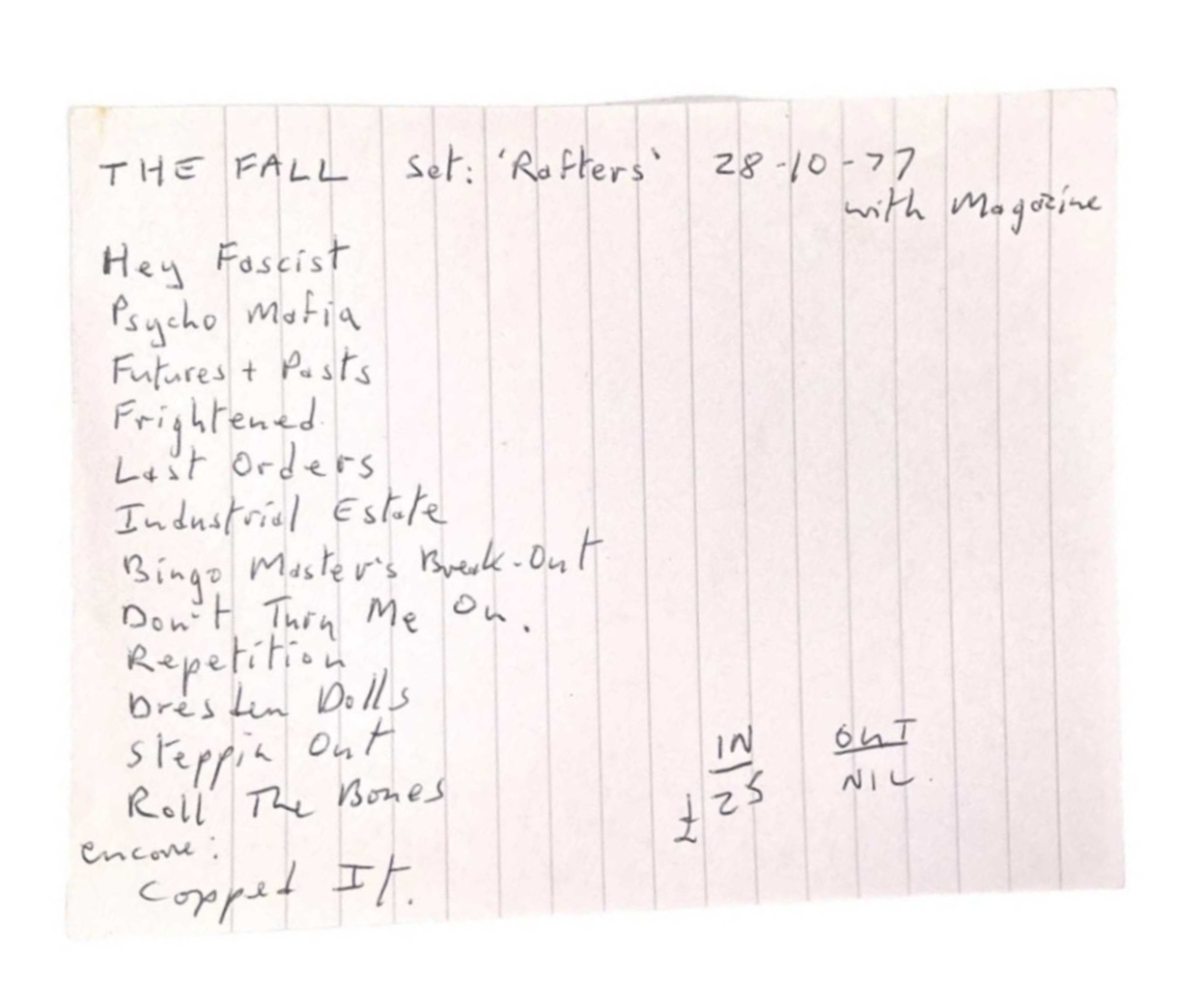
The emerging Magazine had gained some traction after their debut at the final Electric Circus gig and were the headliners. As reported in the Oh Brother podcast future members Marc Riley and Steve Hanley were in the audience and would soon become roadies for the group.
The following Thursday the group would enter Indigo Studios9 in Manchester and record four tracks - Bingo Master’s Breakout, Psycho Mafia, Repetition, and, Frightened. The session was financed by Buzzcocks’ manager Richard Boon. The first three tracks would eventually be released in August 1978 on the “Bingo Master’s Breakout” single on Step Forward. Frightened from this session has never been released as far as I know.
A gig at a venue that the group would play on a number of occasions took place on on Sunday, 13 November, 1977. The Band On The Wall10 on Swan Street in the Manchester Northern Quartet was the epicentre of the work of the Manchester Musicians Collective which had transferred its live endeavours to the venue. An eclectic line-up promised Jazz, Rock, Experimental Music, Music Theatre, and Electronics, The Fall headlined a packed agenda including Albert Square11, The Mekon12, On The Rocks13 , The Elite14, Pride15, and Trevor Wishart.
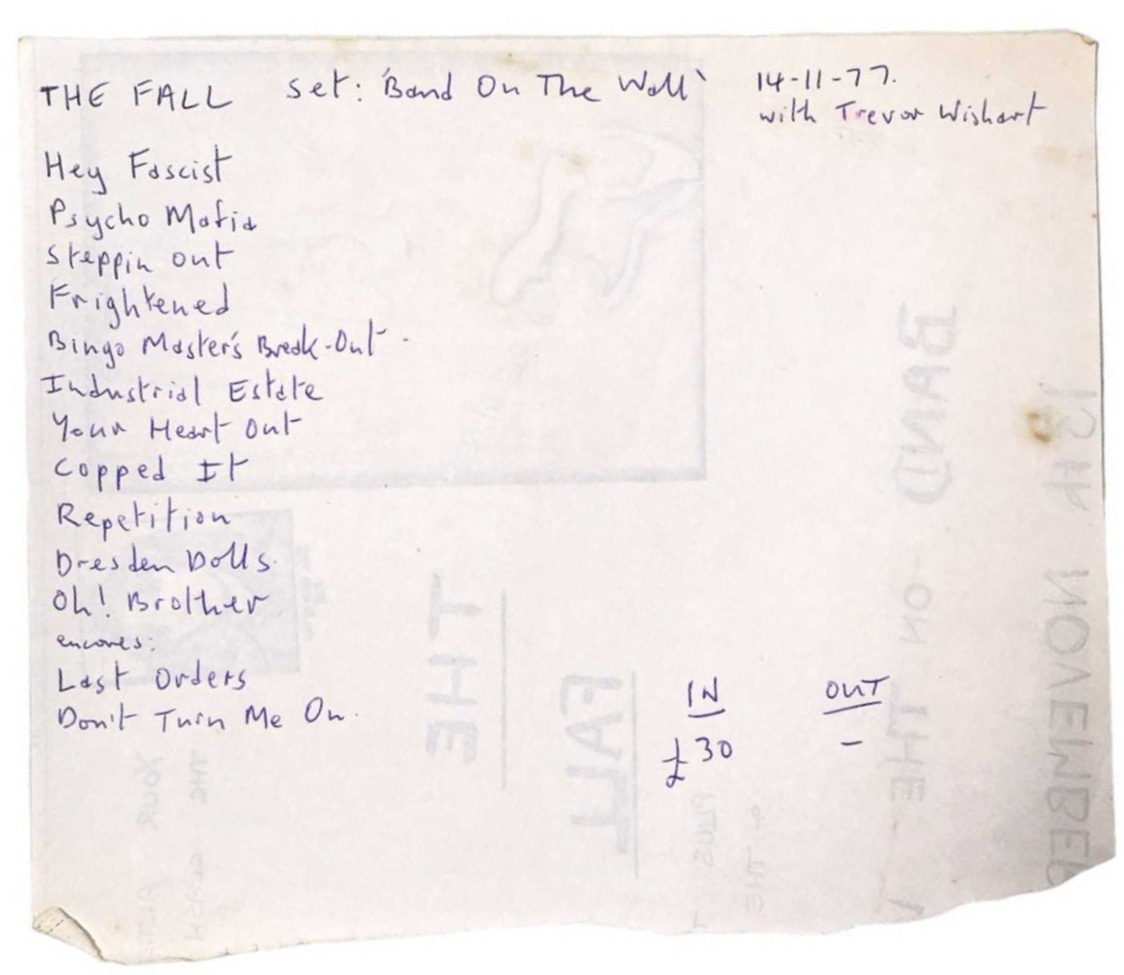
The set was recorded and appears as part of The Fall: The 1970s, 12CD Box Set – released November 2022 via Cherry Red. The version of Bingo-Masters Breakout from this gig appears on the The Indie Scene 7816 release. The second airing of Your Heart Out which would be retired after this show to re-appear in 1979.
What survives is a back of the room recording dominated by loud guitar and bass. The opening soundcheck reveals nothing other some guitar chords, bass runs and some complex rolls by Mr Burns. “Intro. Instrumental” is probably “Gunslinger” by Bo Diddley but there are no vocals. “Hey Fascist” is in very basic early form and nothing like the final version. It is dominated by a slow bass rolling riff and structurally has a very early punk feel. Smith is just about audible and if there are any drums they are not audible. “Psycho Mafia” is mostly drowned out by bass but the drums are audible. Before “Stepping Out” Mark says “can we have a plaster for the drummer please he’s cut his hand”. Bramah’s guitar begins to come through on this but Friel’s bass again tends to dominate and the drums get lost again. You do get a sense of the groups attack and presence. Extensive guitar noodling precedes Frightened whilst a plaster is acquired. The sounds settles down for this quieter number and all instruments are just about audible, unfortunately so is a chattering punter who mutters along during the track. It is good early reading. By now the bass seems to have been turned down and there are good versions of “Bingo Masters”, “Industrial Estate”, and the second peformance of “Your Heart Out” which is structurally completely different from what it would become, the main riff sounds very much like the one used for “Winter”. “Copped It” is very speedy and a little untogether. “Repetition” clocks in at nearly seven minutes and somehow loses its way. “Dresden Dolls” is a little incoherent in places and Burns’ drumming seems a little too busy, again elements of later Fall music are in play with the main chord/riff. “Oh Brother” adopts a Bo Diddley rhythm and sounds nothing like the final version. “Last Orders” is The Fall shaking off the lingering remnants of 1976. To conclude at long last a version of “You Don’t Turn Me On” which can be heard, just. It is a speedy jangly affair which reflects American influences in the chorus and in the verses have a feel of “It’s The New Thing”.
The groups first appearance in Liverpool was on Friday, 18 November at Eric’s17.
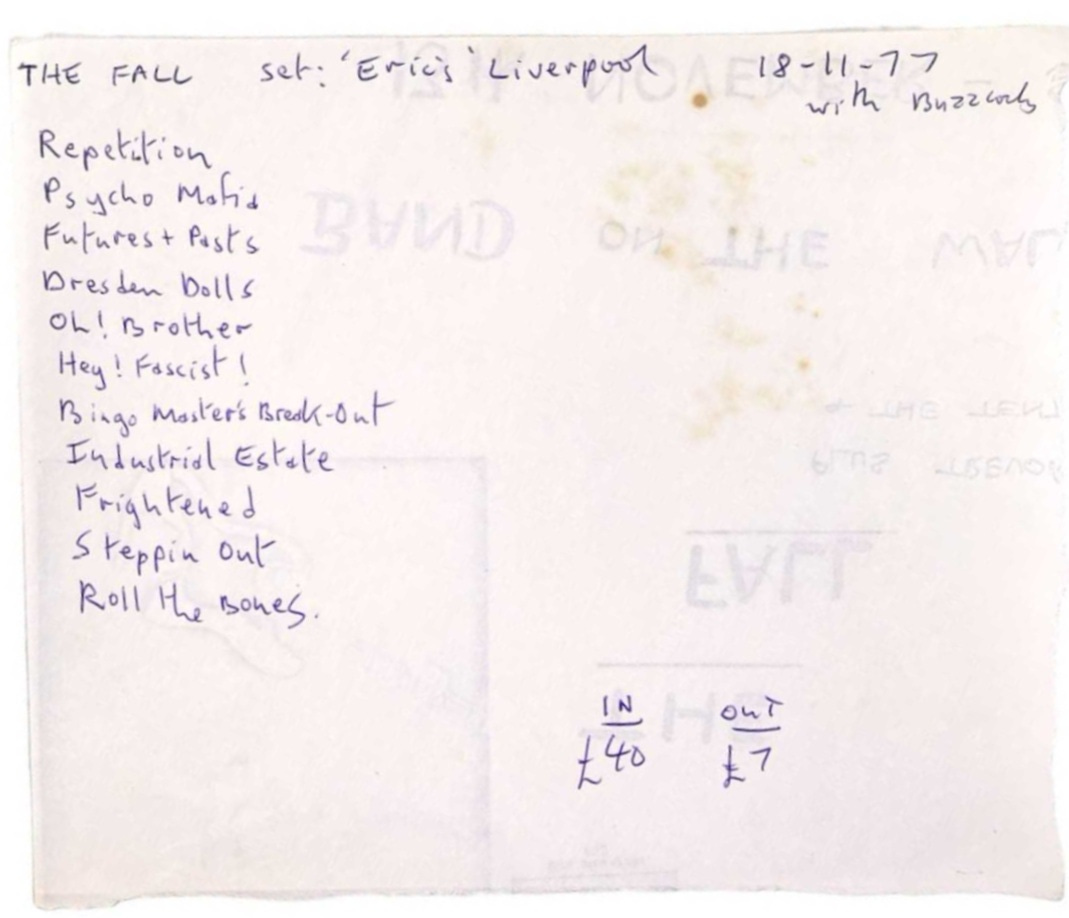
There is no known recording of the gig, the group were second on the bill, between the Toilets18 and Buzzcocks.
At this point it must have been known that Friel was departing as an advert appeared in the 19 November edition of the NME - oddly looking for a guitarist with “imagination and gear”.
The following Tuesday the group were back in London for their first appearance at the legendary Marquee Club. Buzzcocks headlined and The Worst were also on the bill
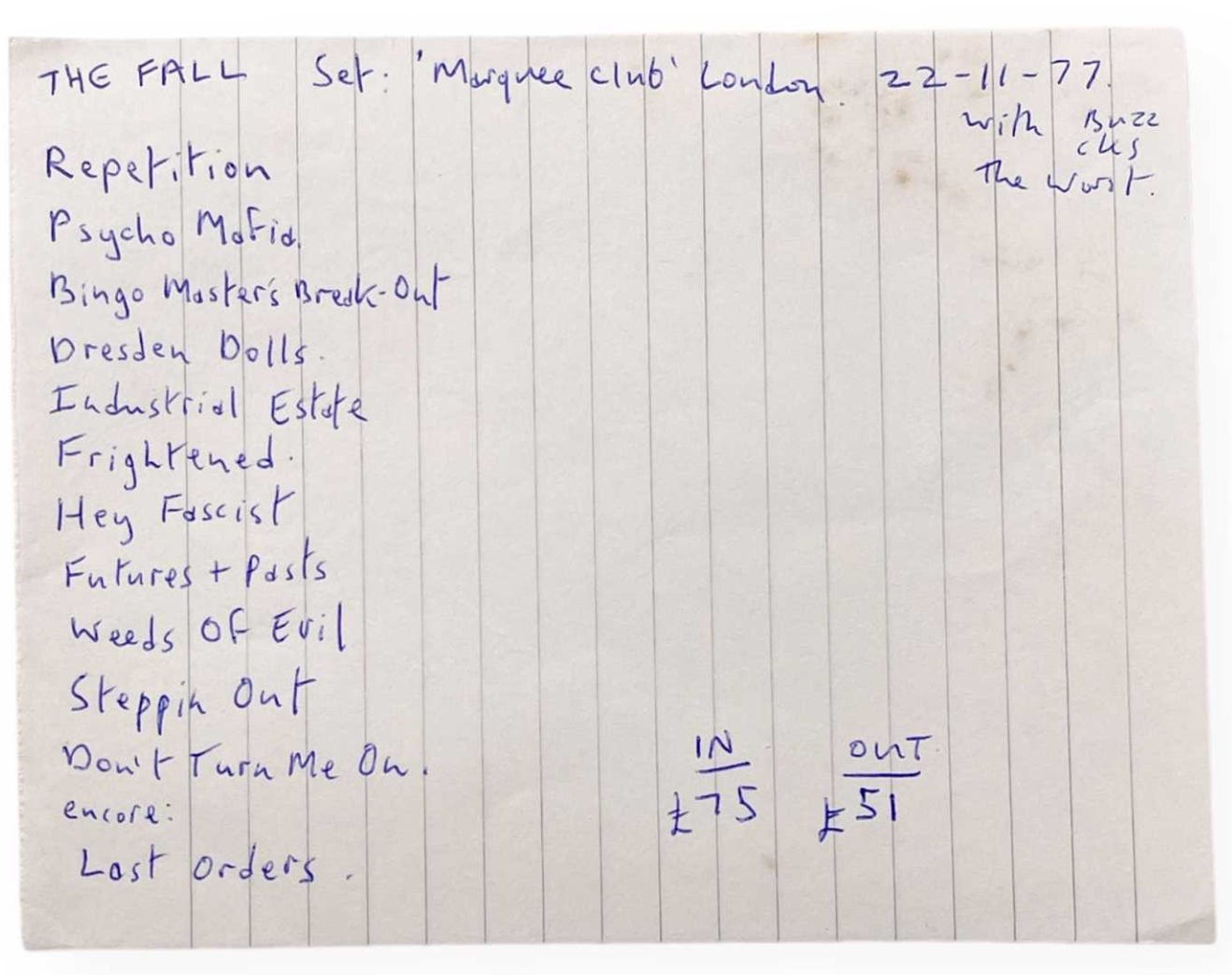
Whilst there is no recording available the set list reveals a new song called Weeds of Evil (see above).
Three weeks off and the group began the first of three December gigs on Friday 16th at St. John’s College.
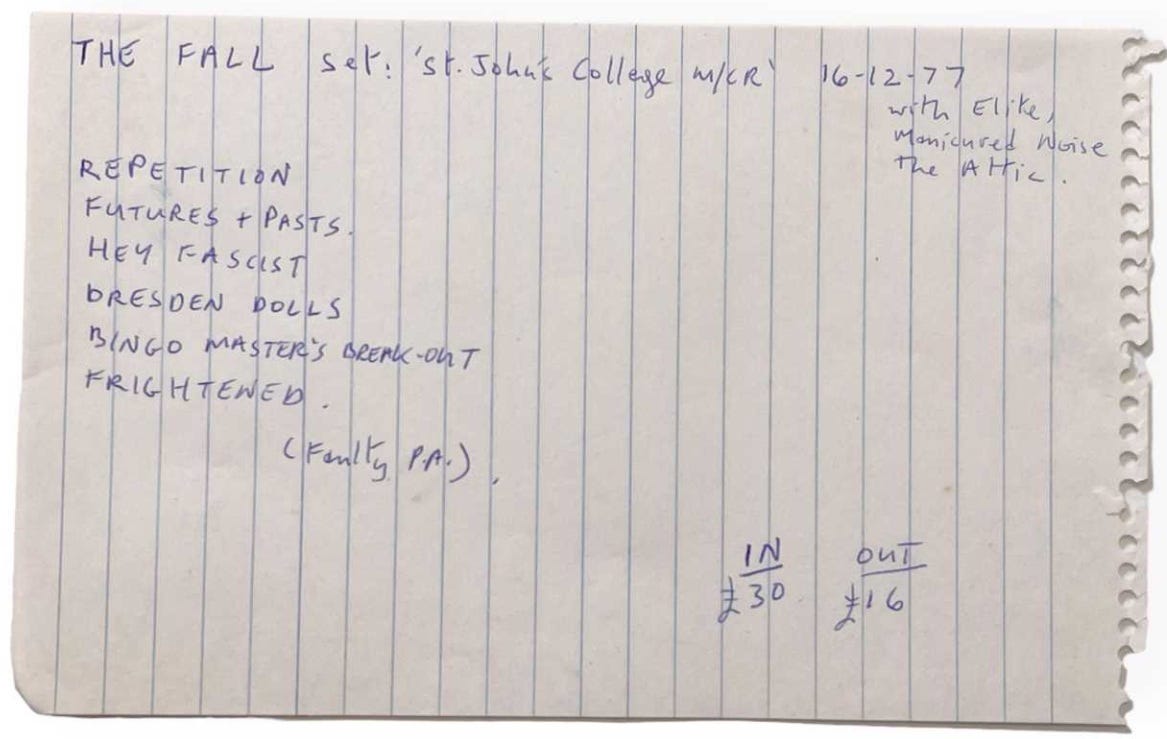
Supports were Manicured Noise19 , The Elite, and The Attic. Reports of a “full scale riot” associated with the gig explain the curtailed set-list, along with the noted “faulty pa” . There is no known recording.
Saturday, 17 December, saw the group returning to Eric’s, Liverpool, England as a support to Penetration. There is no recording but once again a setlist was made.
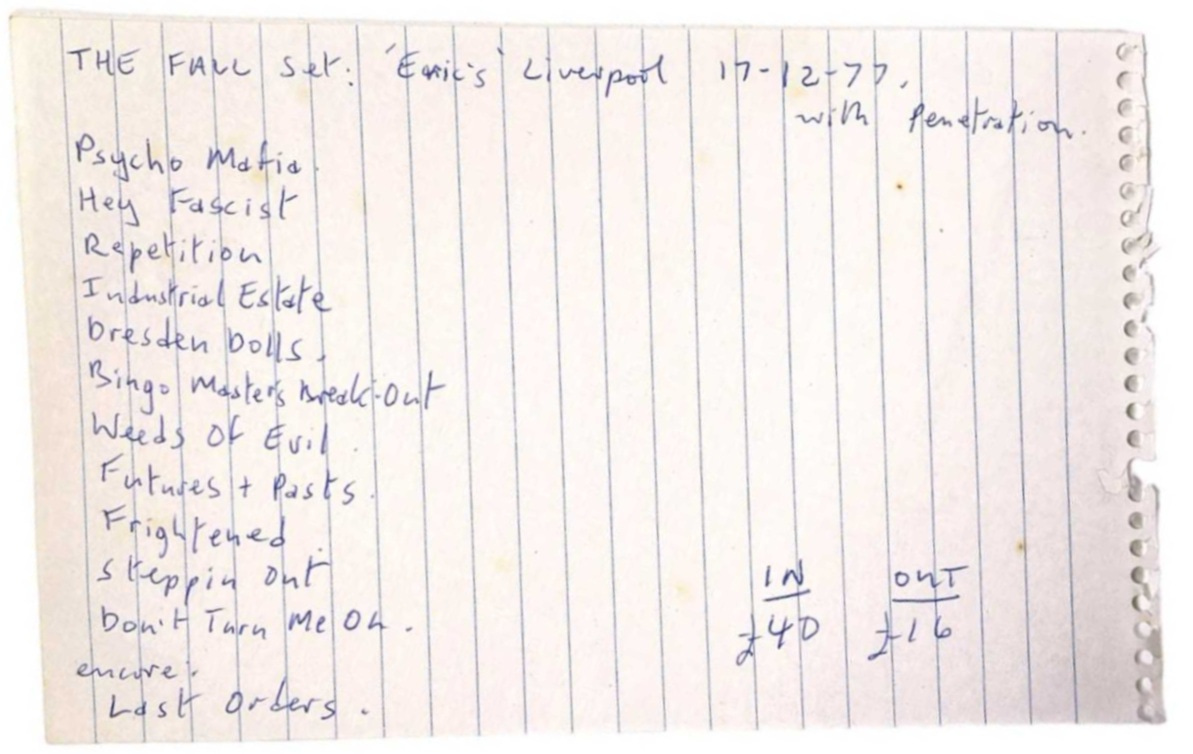
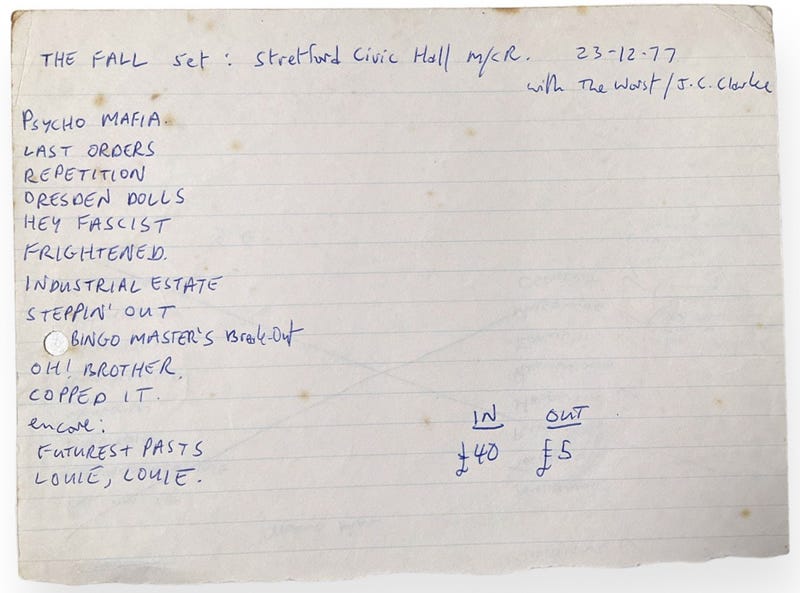
The final gig of the year would be Tony Friel’s last appearance with the group20. Friday, 23 December saw them at Stretford Civic Theatre, in Trafford in a Rock Against Racism gig with The Worst and John Cooper-Clarke. A recording of the gig was made from the soundboard which has been released several times under different names21. Jon The Postman appears as guest vocalist on Louie Louise a completely manic and sloppy version which features harmonica backing and a barking mad end session which is a unique listening experience. Putting aside the irritating “needle hits red” vocal dynamics this is captivating stuff. Given what was going down at the time this is just as refreshing, shocking and frightening now as it must have been then. It makes the tired and tedious contrived show business semi-panto punk nonsense that was coming out of the capital at the time. The gig was interrupted by an attack by National Front activists and the group were protected by a safety curtain as they played.
A fairly stable second half of the year concluded with a change which hinted at some of the major line-up upheaval to come in 1978
Barbarellas was a legendary nightclub that served as a focal point for the UK’s burgeoning punk and new wave scenes during the 1970s. Located on Cumberland Street and owned by Eddie Fewtrell, the venue was famously named after the 1968 Jane Fonda film. While it initially opened as a more conventional discotheque, it gained historical significance for hosting early, era-defining performances by bands such as The Clash, Sex Pistols, The Jam, and Joy Division. The club was celebrated for its inclusive atmosphere and its role in fostering a distinct youth subculture in the West Midlands. Beyond punk, it also embraced the New Romantic movement and electronic music, providing a stage for local acts like Duran Duran and UB40 before they achieved global fame. Despite its cultural impact and status as a cornerstone of Birmingham’s musical heritage, Barbarellas closed its doors in 1979 as the city’s nightlife landscape began to shift.
Jon Savage, reviewing the gig at the Electric Circus said of The Fall that they were “competent but uninspiring” (“Power Cut at the Electric Circuit”, Sounds, 15 October 1977). However, when reviewing the limited 10″ release of Short Circuit – Live at the Electric Circus he was more generous, describing Stepping Out as “muscular modern dance” and having “hypnotic time, electric piano fills and growled lyrics”. (“Conurbation Rock”, Sounds, 24 June 1978).
X-O-Dus (originally performing simply as Exodus) were a pivotal but often overlooked component of the Manchester post-punk explosion in the late 1970s. Hailing from Moss Side , they provided a crucial sonic bridge between the city’s burgeoning punk movement and its vibrant Caribbean community.
A short-lived but energetic part of the late 1970s Manchester scene. While they didn’t achieve the lasting fame of their contemporaries they were a fixture of the local circuit between 1976 and 1978. They were known for their tight, melodic approach, which stood in contrast to the more chaotic performances of early punk groups. Their line-up featured Howard “Howie” Walmsley on saxophone – a rare addition for a punk band of the era - he later featured in Ludus and The Diagram Brothers.
Malcolm Heyhoe, “The Fall: Katie’s, Nottingham, 10 December 1977
http://www.boredteenagers.co.uk/
The original GTs were a short-lived but notable three-piece punk band active around 1977–1978. They were formed from the remnants of a school band and are often cited in archives of the early Nottingham and Derby punk scenes. The line-up wasTony Berrington (aka Neil Downe) – Vocals and Guitar, Kevin Green – Bass and Vocals and Paul Betts – Drums. Their primary claim to fame is the track “Millionaire,” which appeared on the legendary 1977 Raw Records compilation Raw Deal. They also recorded a song called “Move On.” After the band split, Berrington and Green joined members of the Nottingham pub rock band Plummet Airlines to form The Favourites, a power-pop group known for their cover of ABBA’s “SOS.” Kevin Green later became a successful studio installer, working with high-profile artists like Depeche Mode and Vince Clarke.
A respected expert on The Fall whose site mirrors The Track Record with a detailed analysis of the groups output
Indigo Sound Studios was at the epicentre of the late 70s Manchester music revolution. Located on Gartside Street, it became the birthplace of the DIY independent music scene that would eventually define the city’s cultural legacy. The year began with the landmark release of the Buzzcocks’ “Spiral Scratch” EP on 28 January 1977. Though released in January , it was recorded in a frantic five-hour session (three hours for recording, two for mixing) on 28 December 1976. It was produced by Martin Hannett (credited as “Martin Zero”), it was the first self-funded, independently released punk record in the UK. The studio’s 16-track Ampex equipment captured the raw, “scratchy” aesthetic that became a blueprint for post-punk.
Located in the heart of Manchester’s Northern Quarter, Band on the Wall is a multi-award-winning live music venue with a rich history dating back to the nineteenth century. It earned its distinctive name from the early twentieth-century practice of placing musicians on a high stage mounted to the back wall to save space for dancers in the crowded pub below. Following a major refurbishment and expansion, the venue now boasts state-of-the-art acoustics and a diverse programme that spans jazz, folk, blues, and world music, as well as contemporary electronic and indie acts. Beyond its reputation as an intimate space for international touring artists, it functions as a non-profit centre for musical education and community engagement, cementing its status as a cornerstone of the city’s cultural heritage.
Albert Square was a short-lived but fondly remembered Manchester band active during the late 1970s. Closely associated with the Manchester Musicians Collective, they frequently shared bills at Band on the Wall with legendary peers such as The Fall, Joy Division (then Warsaw), and The Manchester Mekon. The group is perhaps best known for their track “Into The Night,” which was featured on the seminal 1979 compilation A Manchester Collection (released on the Object Music label). This record is considered a vital document of the city’s post-punk transition, capturing the DIY spirit of the MMC scene. While they did not achieve the same level of national fame as some of their contemporaries, Albert Square remains a significant “lost” piece of Manchester’s musical puzzle, representing the experimental, community-driven energy that defined the Northern Quarter long before its modern gentrification.
While often confused with the Leeds-based post-punk band The Mekons, The Manchester Mekon (originally just The Mekon) was a distinct entity and a key fixture of the Manchester Musicians Collective . Formed in 1977, the band was led by guitarist and technical whiz Frank Ewart, alongside members Louise Alderman (bass), David Pimlott (vocals/guitar), Francis Alford (keyboards), Chris Parkinson (drums), and Chris Griffin (flute). They were forced to add “Manchester” to their name at the request of MMC organiser Dick Witts to avoid confusion with their increasingly famous Leeds counterparts. Operating out of a communal house on Burton Road in south Manchester that served as an unofficial headquarters for the scene—where members of The Fall and Joy Division were known to jam—the band occupied a unique space in the city’s musical landscape. Eschewing the aggressive minimalism of many punk peers, they were influenced by the experimentalism of Frank Zappa, Stravinsky, and Pink Floyd, aiming to blend improvised rock with electronic and orchestral textures. Though sometimes derided by local press as “dull” or “hippyish” due to their more avant-garde leanings, they were a staple at Band on the Wall and featured on the 1979 Object Music compilation A Manchester Collection with the track “The Cake Shop Device.”
On The Rocks was an energetic Manchester rock band active during the late 1970s, While they did not release a full-length studio album that achieved national mainstream success, they are immortalised in the Manchester Digital Music Archive through concert posters and flyers from 1977. Their sound was typical of the era’s “pub rock to punk” transition—rough, authentic, and rooted in the city’s burgeoning DIY underground. Although they remain one of the more elusive names from that specific wave, their participation in the MMC solidified their place in the foundation of the post-punk movement that would eventually put Manchester on the global musical map.
The Elite formed in Stockport in 1977 by Stockport schoolfriends Mick Coates, (vocals), Kevin Eden (guitar, vocals) and Peter Hibbert (drums, vocals). Taking their inspiration from Buzzcocks’ ‘Spiral Scratch’ EP, they were lured into punk from an existing preference for glam, prog and singer-songwriters. Eden and Hibbert wrote most of the material, which was recorded in the latter’s parents’ kitchen on a basic cassette recorder, with plastic containers serving as a drumkit. A series of cassette recordings were circulated among friends. The Elite joined the Manchester Musicians Collective in 1978 and performed at their King Street basement using borrowed equipment – including the first drum kit Hibbert had ever used. The original trio had been augmented by bass player and schoolfriend Mick Church, an unrepentant Deep Purple fan, as they began to pick up gigs in the Manchester area. But by 1978 tensions between Church and Coates led to the latter walking out during a rehearsal. Eden took over lead vocals as they continued as a three-piece, but soon Church wanted to move on, although he did agree to play at their final show at the Band On The Wall on July 29th.
Best remembered for their appearance on the 1980 compilation album Unzipping the Abstract, which was the second major release from the MMC on the Object Music label (following 1979’s A Manchester Collection). Pride contributed the track “Rough Justice” to the record, which captured the gritty, socially conscious, and often dissonant sound typical of the Manchester underground at the time.
Released in September 1991, The Indie Scene 78 is a notable volume in the acclaimed “Indie Scene” compilation series issued by the Connoisseur Collection label. The album serves as a curated time capsule of the UK’s alternative and underground music landscape from the 1978. The tracklist is a comprehensive 24-song collection that balances iconic anthems with rarer cult classics.
Opened on 1 October 1976, Eric’s was a legendary basement club on Mathew Street that served as the epicentre of Liverpool’s punk and post-punk explosion. Founded by Roger Eagle and Ken Testi (later joined by Pete Fulwell), the venue was intentionally named “Eric’s” as a plain, “Anglo-Saxon” alternative to the more pretentious disco club names of the era, such as Tiffany’s or Samantha’s. Situated directly opposite the site of the original Cavern Club, it provided a vital bridge between the city’s Merseybeat past and its avant-garde future.
The Toilets were Rhyl’s first punk band, emerging in 1977, and formed by Mike Peters, later of The Alarm. They were semi-regulars at Eric’s and their manager was Chris Harrap, the Eric’s DJ.
Manicured Noise was formed in Stockport in 1977. The band’s name was created by Linder Sterling, designer of the album covers for Buzzcocks and singer for Ludus. There is little information about the early days of the band. The founding members were Owen Gavin, on vocals, and Stephanie Nuttal , on drums. Other consistent members were Jodie Taylor on bass and Peter Bannister on saxophone. During its first year, the band had gone through a number of guitarists including Jeff Noon, years later a renowned science fiction writer (Vurt etc), Arthur Kadmon and from September 1978, Steve Walsh, ex-guitarist of The Flowers of Romance After his departure, Kadmon formed Ludus, along with Linder Sterling and ended up being involved in the recordings for Room To Live.
He left to form The Passage with Dick Witts and Lorraine Hilton.
As a CD as Live 77, as a limited edition “Rock Against Racism Stretford” limited edition white label vinyl “test pressings”, and, as part of The Fall: The 1970s, 12CD Box Set on Cherry Red